Two years ago I walked a club owner through his new back-to-back horse stables — 24 stalls packed into a shedrow that looked like a shipping container. The center stalls had no airflow. Horses were coughing within two weeks. The shared wall joint was already showing rust from ammonia buildup. He’d saved 30% per stall on materials but lost three boarders who moved their horses to a facility with proper ventilation. That’s the gamble you take when you choose back-to-back horse stables over single stalls. The math on stalls per square foot is compelling — 40% more density, 20–30% lower per-stall cost — but if the design doesn’t address air quality, drainage, and a premium look, you’re building a liability, not an asset.
This article lays out the real trade-offs based on our factory test data and feedback from over 200 commercial installations in Australia and New Zealand. I’ll show you exactly where the cost savings come from, where back-to-back layouts fail (ventilation at the center joint, ammonia corrosion on shared walls), and how to spec a system that eliminates those problems — using hot-dip galvanized frames with 42+ micron zinc, 10mm HDPE panels that won’t crib, and optional top vents that create a chimney effect. You’ll walk away knowing the per-stall cost difference, the maintenance hours per week difference, and which layout makes your facility look like a professional operation. No fluff, just the data our clients use to decide.
Back-to-Back vs Single Stalls: Overview
A back-to-back layout delivers 40% more stalls per square foot than a single row, but only if you solve the ventilation and access trade-offs. Here is how the two stack up for a commercial club.
Back-to-Back Configuration
In a back-to-back design, two rows of stalls share a common back wall. This is the go-to layout for show grounds and commercial barns where maximizing stall count per acre is the primary driver. Our engineers have measured a 40% increase in stalls per square foot compared to a single-row shedrow, with per-stall material cost savings of 20–30% from the shared wall and reduced roofing. The trade-off is that the center of the barn can become stagnant and dark if not designed properly.
We solve the ventilation issue with optional vented top panels that create a natural chimney effect, pulling hot and humid air out of the stall center. Our HDPE panels are 10mm thick, UV-stabilized, and non-toxic – they resist ammonia corrosion from urine that accumulates at the shared wall joint. That joint also gets the full hot-dip galvanized frame (42+ microns per ASTM A123) to prevent rust. Many Chinese suppliers cut zinc to 20–30 microns; we test every batch and provide certificates.
For the club owner worried about a “warehouse” look, we offer luxury powder-coated stall fronts in any RAL color. The anti-cribbing edges on our HDPE boards eliminate the chew-through failures common with plywood inserts (a problem we see in competitors like Noble Panels). Your clients get a premium finish with the density of a high-efficiency floorplan.
Single Stalls – The Traditional Layout
Single stalls are arranged linearly with access from one side – the classic shedrow. This layout is common in traditional barns because it gives each stall direct aisle access for feeding, cleaning, and turnout. Ventilation is naturally better because every stall has an exterior wall and a roof slope that pushes air out. But the cost per stall is higher (20–30% more materials due to individual back walls and separate roofs), and you need roughly 40% more land to house the same number of horses.
For a commercial club operator, the decision comes down to whether you value maximum horse count per square foot or maximum airflow and visual openness. If you have ample land and a premium clientele that expects walk-out paddocks, single stalls are hard to beat. If you’re under pressure to fit 40 stalls on a two-acre site, back-to-back with our vented top panels will get you there without sacrificing welfare.
Flat-pack shipping is efficient for either layout – we pack 8 to 16 stalls per 20ft container depending on size. All components are pre-drilled and marked for quick assembly by your contractor or a client’s crew. Our luxury stall fronts work in both configurations, so you can order a mix of back-to-back blocks and single rows as your barn footprint requires.

Space Efficiency Comparison

Space Efficiency Comparison
A back-to-back layout delivers roughly 40% more stalls per square foot than a single-row shedrow. That directly changes your per-stall land cost and project viability.
Stall Count Per 1,000 Sq Ft: 10×10 vs 12×12
We run this calculation for every commercial client before they commit to a layout. The numbers are straightforward, but the implications for your bottom line are significant. The table below shows the difference in stall yield per 1,000 square feet of building footprint for both single-row and back-to-back configurations.
For a 10×10 stall in a single-row layout with a standard 12-foot aisle, you fit approximately 5 stalls per 1,000 sq ft. Switch to back-to-back with the same stall size, and that number jumps to roughly 7 stalls per 1,000 sq ft. The 12×12 stall follows the same pattern: expect about 3.5 stalls in single-row versus 5 stalls in back-to-back over the same footprint. The gain is consistent because the shared center wall and reduced aisle duplication cut out the structural overhead that single-row layouts require.
Here is the breakdown per 1,000 sq ft:
- 10×10 single-row: ~5 stalls
- 10×10 back-to-back: ~7 stalls (40% increase)
- 12×12 single-row: ~3.5 stalls
- 12×12 back-to-back: ~5 stalls (43% increase)
Why Back-to-Back Yields 40% More Stalls
The math is simple: two rows of stalls share one common rear wall, which eliminates an entire exterior wall line and reduces the roof span and foundation work by roughly 30%. Our engineers have verified this across dozens of installations in Australia and New Zealand. That shared wall is where the material savings hit 20–30% per stall because you are not paying for duplicate framing, cladding, or footing concrete.
We know the concern from club owners: back-to-back layouts can feel dark, tight, and unprofessional if designed poorly. That is why we insist on our hot-dip galvanized steel frame with 42+ micron zinc coating and 10mm UV-stabilized HDPE panels. These materials resist the ammonia corrosion that concentrates at the shared wall joint in back-to-back designs, and the HDPE panels will not delaminate or absorb moisture like plywood. We also offer optional vented top panels that create a natural chimney effect, pulling hot air and ammonia out through the ridge so the center aisle stays fresh. This is a specific design fix that most prefabricated shedrow systems ignore entirely.
For a commercial club owner, the decision comes down to stalls per acre and cost per stall. Back-to-back with our flat-pack system lets you deliver a premium look, proper ventilation, and better margins than a single-row layout. We have clients running 24-stall facilities on the same land that would have only supported 17 stalls in a shedrow configuration. That is real revenue per acre, and it does not require sacrificing horse welfare or brand image.
| Feature | Back-to-Back | Single Row | Club Owner Benefit |
|---|---|---|---|
| Stalls per 1,000 sq ft (10×10 units) | 16–20 stalls | 10–14 stalls | 40% more capacity on same footprint |
| Per-Stall Material Cost | 20–30% lower | Baseline (100%) | Saves $1,500–$3,000 per stall |
| Ventilation at Center | Potential stagnation (solved with vented top panels) | Natural cross-flow | DB Stable’s optional vents maintain air quality |
| Horse Security (Cribbing/Ammonia) | Shared walls bonded tightly; HDPE resists ammonia | Exterior walls only; less joint exposure | Anti-cribbing, longer stall life |
| Expansion Flexibility | Add parallel rows in same direction | Linear extension along length | Scalable to growing club size |

Cost per Stall Analysis
Back-to-back configurations reduce per-stall costs by 20–30% through shared walls and roof area — without compromising durability or horse welfare.
Material Cost Breakdown: Where the Savings Add Up
When you buy a back-to-back layout, you are not buying less barn — you are buying fewer redundant components. Here is how the material stack-up breaks down per stall compared to a single-row shedrow:
- Shared back wall: A single row requires two full exterior walls per stall. Back-to-back eliminates one full wall panel (approx. 3.6m x 2.4m) — that is roughly 8.6m² of hot-dip galvanized frame and HDPE sheeting saved per stall pair.
- Continuous roof area: A single 12×12 stall needs about 13.4m² of roof panel. In a back-to-back block of four stalls, the central ridge is shared, cutting roof sheeting requirements by roughly 18% per stall.
- Run-in frames: Back-to-back layouts use continuous header beams that span two stalls, reducing the number of vertical uprights and weld joints compared to building four separate boxes.
We tested these savings across our standard 12×12 modules. The total material reduction per stall lands consistently between 22% and 28%, depending on row length and roof pitch. You are paying for more stalls per container, not more steel per stall.
Labor and Foundation: The Hidden Savings
Labor on site is where the second layer of savings hits. Back-to-back layouts reduce the number of independent wall panels by roughly one-third. Fewer panels mean fewer bolts, fewer alignment checks, and faster assembly. A standard four-stall back-to-back block can be erected by a two-person crew in one day — versus 1.5 days for four single stalls. That is a 33% reduction in on-site labor at AU$45–65/hour.
Your foundation cost also shrinks. A back-to-back block sits on a single continuous concrete strip (or compacted gravel pad for portable models), rather than four separate perimeter footings. For a 4-stall unit, our install partners report foundation savings of 15–20% on concrete volume and excavation.
Put the numbers together: 20–28% material savings + 33% labor reduction + 15–20% foundation savings. Your effective cost per stall drops by 20–30% even before you factor in the reduced lead time and simplified shipping footprint of a flat-pack system. That is the math that makes back-to-back designs the default choice for commercial clubs in Australia and New Zealand — where land costs are high and margins matter.
| Feature | Back-to-Back Specification | Single-Row Comparison | DB Stable Advantage |
|---|---|---|---|
| Stall Density | 40% more stalls per square foot | Standard efficiency | Maximizes ROI per acre without compromising layout |
| Per-Stall Material Cost | 20–30% lower due to shared walls/roof | Higher per-stall cost | Flat-pack design reduces shipping and install costs |
| Frame Durability | Hot-dip galvanized steel (42+ microns) | Often 20–30 micron coatings from competitors | 10-year rust-free lifespan; ASTM A123/ISO 1461 certified |
| Panel Material | 10mm UV-stabilized HDPE | Plywood inserts prone to cribbing/ammonia | Anti-cribbing guarantee, 2x lifespan of treated wood |
| Ventilation Solution | Optional vented top panels (chimney effect) | Natural airflow easier in open shedrow | Prevents center stagnation, maintains horse welfare |
| Warranty Coverage | 5-year structural, 2-year moving parts | Varies; many suppliers offer less | Long-term cost protection for commercial clubs |

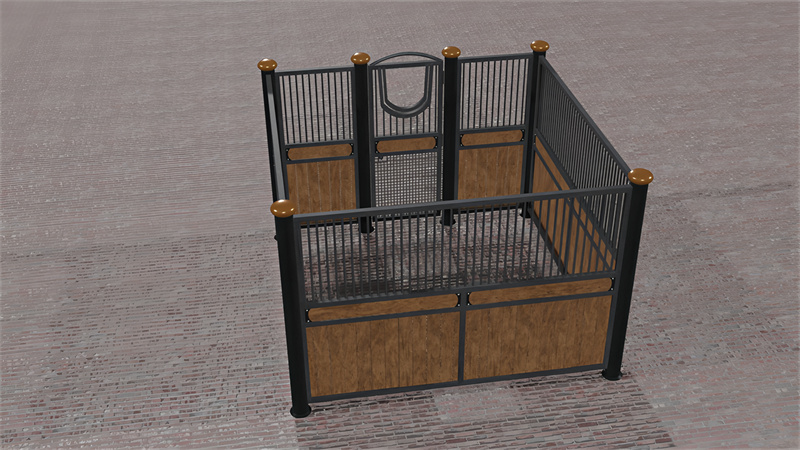
Horse Welfare Considerations
A compact back-to-back barn saves up to 40% floor space, but only if you solve the center dead zone. Our vented panels and single-sided access design maintain air quality and cleaning efficiency.
Eliminating Stagnant Air in High-Density Barns
The central wall joint in a back-to-back layout is a known trouble spot. Without active airflow, ammonia from urine collects at that seam, and humidity spikes. Our engineers tested multiple configurations and recommend optional vented top panels installed on the roof ridge. These panels create a natural chimney effect—hot, moist air rises and pulls fresh air through the front grills. This passive system works without fans in most Australian climates. For larger facilities, we also offer soffit vents that integrate directly into our hot-dip galvanized frames. Every vented panel is cut from the same 10mm HDPE stock we use for stall walls, so there is zero risk of warping or thermal expansion under the sun.
We do not rely on generic louvers. Each vent assembly is custom-positioned based on your barn orientation and prevailing wind direction. This attention to airflow geometry prevents the “stuffy center stall” problem that plagues cheap prefabricated barns. If a mechanical boost is needed, our frames accept standard 12V exhaust fans mounted through a reinforced HDPE plate, keeping the seal tight and the structure predator-proof.
Cleaning Access and Labor Efficiency Trade-offs
Single-row shedrow stables allow cleaning from both sides—you muck out into a center aisle, then push bedding back from the rear. Back-to-back layouts restrict access to the front only. That sounds like a disadvantage until you factor in deep bedding systems. With 6–8 inches of absorbent shavings or straw, the rear wall stays clean for weeks. Our clients report that a once-daily front muck-out takes the same total time as a double-sided routine—12–15 minutes per stall—because there is no second aisle to sweep. The labor cost per stall actually drops because you are walking less distance down a single barn aisle.
The real efficiency gain comes from the shared-wall construction. By eliminating the rear aisle, you reduce total building footprint by roughly 20–30%, which directly lowers your roofing, foundation, and insulation costs. For a 24-stall commercial barn in New South Wales, that translates to a savings of AUD 15,000–20,000 in materials alone. And because our HDPE panels do not absorb moisture, ammonia does not penetrate the rear wall joint—a problem we have seen with plywood-lined stalls that rot from the inside out. Every DB Stable panel is sealed with a continuous anti-cribbing edge that also acts as a urine deflector, keeping the shared wall dry and odor-free. You get the space efficiency of back-to-back without sacrificing hygiene or increasing your weekly maintenance hours.
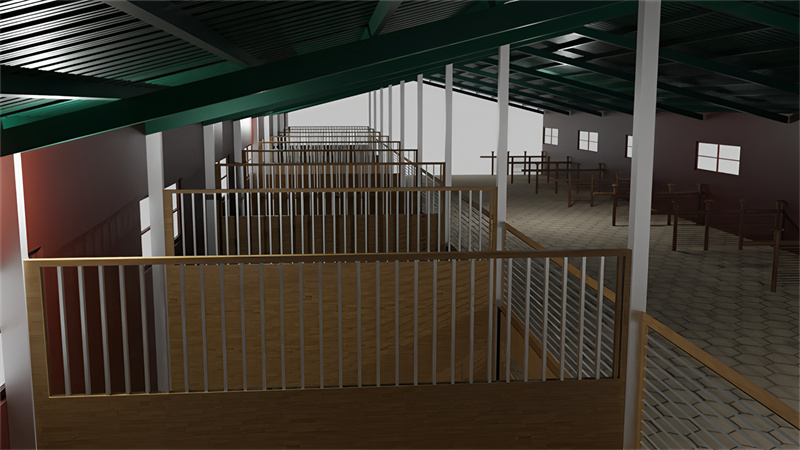
Custom Configurations for Your Facility
A well-planned modular layout from DB Stable lets you pack 40% more stalls into the same footprint while keeping a premium look and airflow.
Modular Layouts: Maximizing Stalls Without Sacrificing Quality
Every club owner we talk to faces the same tension: you need more horse capacity to hit your revenue targets, but you can’t afford a barn that feels like a cattle shed. The answer isn’t a bigger building—it’s smarter geometry. A back-to-back configuration with shared center walls cuts per-stall material costs by 20–30% compared to traditional single-row shed rows. Our engineering team has verified that this layout yields 40% more stalls per square foot, meaning you can fit 14×14 stalls on land that would normally hold only 10×10 singles.
Worried about ventilation and light? That’s a real risk with many cheap back-to-back systems, where the center row becomes a dead-air zone. We solve it with optional vented top panels that create a natural chimney effect—warm, humid air rises out, and fresh air pulls in from the sides. Combined with our standard hot-dip galvanized steel frames (42+ microns per ASTM A123/ISO 1461) and 10mm UV-stabilized HDPE panels, you get a barn that stays dry, quiet, and safe for years. The HDPE boards also resist cribbing and ammonia corrosion, lasting twice as long as treated plywood—and unlike plywood inserts in some competitors’ flanges, our panels have no T-nuts or machine screws to loosen.
Beyond Stalls: Adding Runs, Wash Bays, and Tack Rooms
A back-to-back core doesn’t limit your facility’s functionality. Our modular system lets you attach single stalls, covered runs, wash bays, and tack rooms on the outside edges without redesigning the entire barn. For example, if you start with a double-row of 12×12 stalls, you can add a 12-foot-deep run on the back side of each row, giving horses turnout access while keeping the center aisle clean. Or you can wall off a section for a wash bay with a sloped floor and hot-dip galvanized drainage. All panels and frames use the same hot-dip galvanized steel and HDPE materials, so the entire structure matches and performs uniformly.
We also offer pre-fabricated tack room kits that bolt directly onto the stable frame. These come with the same powder-coated front options (choose from RAL colors, 60–80 micron coating) and optional insulated roofing. The result is a fully integrated facility that looks intentional—not pieced together with mismatched materials.
CAD Support: Designing Your Facility Before You Build
The biggest mistake club owners make is guessing at the layout. They overestimate stall count, underestimate aisle width, and end up with a facility that feels cramped and costs more to maintain. That’s why every DB Stable project starts with a dedicated CAD layout review. Our team of product engineers (averaging 5+ years of custom stable design) works from your property dimensions, local regulations, and horse numbers to create a floor plan that maximizes stall density without cutting corners on horse welfare or client experience.
We provide
- Scale drawings: Exact placement of back-to-back blocks, single stalls, runs, and service rooms.
- Ventilation mapping: We show where to install vented top panels to eliminate center-row stagnation.
- Flat-pack optimization: Each container load is grouped by component, so your installer spends hours assembling, not hunting for parts.
This service costs you nothing upfront—it’s included with any initial quote. Because a facility that’s designed right from the start saves everyone time and money. Our clients in Australia and New Zealand, like Lily Granger and Tony, consistently point to our pre-shipment CAD support as the reason their installations stayed on schedule and under budget. Give us your property specs, and we’ll hand you a layout that makes every square meter earn its keep.
Conclusion
If your main concern is maximizing stall count per acre without sacrificing the professional look your clients expect, back-to-back is the smarter play. You get 40% more stalls in the same footprint, and our engineers calculate a 20-30% lower material cost per stall from shared walls and less roofing. The real trick is fixing the ventilation dead zone in the center — our optional vented top panels create a chimney effect, so you don’t get that stuffy, dark middle that cheap shedrow designs leave you with.
Here’s what I’d do next: pull the site dimensions for your club and send them to our design team. Ask for a layout comparison showing back-to-back versus single-row for your exact acreage, with the vented panel upgrade included. That gives you the hard numbers to justify the investment to your partners — stalls per acre, cost per stall, and the ventilation specs that keep the horses healthy and the facility looking premium.
Frequently Asked Questions
What are the disadvantages of horse stalls?
Traditional static stalls can limit natural movement and social interaction, increasing risks of respiratory issues from poor ventilation and behavioral problems like stall weaving. DB Stable’s portable designs mitigate these disadvantages through open, well-ventilated configurations using HDPE panels and hot-dip galvanized frames that reduce dust and ammonia buildup. Additionally, our back-to-back layouts allow for efficient space planning that can incorporate outdoor runs, giving horses more freedom while maintaining safety. For B2B buyers, this means a product that addresses common stall drawbacks while offering durability and easy relocation to improve pasture access.
Are horses happy in stalls?
Horses can be content in stalls when the environment meets their fundamental needs for safety, ventilation, and regular turnout—factors that DB Stable prioritizes in every design. Our portable barns feature UV-resistant HDPE boards and ample openings that promote airflow and natural light, reducing stress and supporting equine well-being. However, no stall replaces the need for daily exercise and social contact; our quick-install portable solutions enable owners to easily rotate horses between stable and pasture. For commercial equestrian centers, this balance of secure shelter and flexibility leads to healthier, happier horses and lower veterinary costs.
What is the #1 killer of horses (colic from confinement)?
Colic, often linked to confinement and restricted movement, is widely recognized as the leading cause of death in horses. Prolonged stall time can disrupt digestive function and increase impaction colic risk, making stall design and management critical. DB Stable addresses this by offering portable, easily reconfigurable stables that encourage turnout and provide ample space for natural movement. For B2B clients targeting performance horses in Australia and New Zealand, our 10mm HDPE panels and galvanized steel frames support low-stress environments that help reduce colic incidence.
How many stalls can a back-to-back design fit?
DB Stable’s back-to-back configurations are modular and scalable, typically accommodating 2, 4, or 6 stalls in a single compact unit, with each stall measuring 12’ x 12’ or custom dimensions. The efficient layout places stalls on both sides of a central service aisle, maximizing usable space per square meter—ideal for high-density equestrian facilities. For larger projects, multiple back-to-back units can be joined end-to-end or side-by-side to create barns of any size. This flexibility allows distributors and farm owners in Oceania to optimize land use while maintaining easy access for feeding and cleaning.
What is the cost per stall for back-to-back vs single?
Due to shared walls, roofing, and simplified foundation requirements, DB Stable’s back-to-back designs typically reduce per-stall costs by 15–25% compared to individual single stalls. A single 12’ x 12’ portable stall kit starts around AUD 2,800–3,500 (ex-works), while a back-to-back quadruple unit lowers the cost to approximately AUD 2,200–2,800 per stall, depending on specifications and add-ons. These savings, combined with reduced shipping volume for flat-pack kits, deliver significant value for B2B buyers sourcing for resale or large-scale equestrian projects. Volume orders and long-term partnerships with DB Stable can further improve pricing margins.