Last spring, a 60-stall equestrian club in Queensland called me about a recurring problem. Their central stalls had a sharp ammonia smell by mid-morning, and three boarders had moved their horses out citing “poor air quality.” The club owner had spent $15,000 on industrial fans and still couldn’t fix it. The root cause wasn’t management or cleaning schedules — it was their horse barn ventilation design. The solid stall fronts and sealed walls created dead air pockets exactly where the horses breathe, at the 3-foot ammonia zone.
That club’s story isn’t rare. In the last five years, I’ve consulted on over 80 barn projects across Australia and New Zealand, and the same five design mistakes show up again and again. This article walks through each one: what I see, why it hurts your horses and your occupancy rates, and the specific specs that fix it. We’re talking ridge vent sizing, stall front materials, and airflow rates in CFM per horse — the kind of numbers you can take straight to your builder.

Mistake #1: Sealing the Barn Too Tight for Winter
Sealing your barn tight for winter warmth is the fastest way to damage your horses’ lungs. The 5–10°F rule exists to prevent condensation and ammonia buildup that drives vet visits.
The 5–10°F Rule Explained
The most common oversight we see in prefabricated barn design is the instinct to seal every gap for energy efficiency. Club owners equate a warm barn with good management — but the physics of horse housing works against you. Every horse produces 2–3 gallons of urine daily. That urine releases ammonia gas, which is heavier than air and settles at approximately 3 ft height — right at your horse’s breathing zone. If you seal the building tight, you trap that ammonia inside.
The rule is simple: your barn interior should never be more than 5–10°F (3–6°C) warmer than the outside air. Beyond that differential, the building’s internal surfaces — windows, steel panels, roof sheeting — drop below the dew point of the warm, moisture-laden air inside. That is when you see condensation.
Frost on Windows or Drip Lines Indicates Low Air Exchange
If you walk into your barn on a winter morning and see frost on the inside of windows, or water dripping down stall fronts, you have a ventilation failure. Those droplets are not just water — they are a nutrient broth for mold, bacteria, and fungal spores. In a sealed barn, the relative humidity often hits 90%+ overnight. At that level, pathogens thrive, and respiratory infection rates climb. For a commercial equestrian club, that means higher vet bills, lower stall occupancy, and the kind of client complaints that get shared on social media.
The recommended baseline is a minimum of 2 air changes per hour in winter, achieved through passive stack ventilation. That requires ridge vents at the peak and eave inlets at the soffit. Ceilings should be 10–12 ft high to create enough vertical space for the stack effect to work. Warm, moisture-laden air rises and exits through the ridge, while cool, dry air is drawn in at the eaves. Interrupt that chimney — by sealing the ridge or blocking eave gaps — and you kill the airflow.
Here is where material choice matters. Wood stall fronts absorb condensation like a sponge, then stay damp for hours or days. Over time, they rot and become permanent reservoirs for mold. Powder-coated steel and HDPE panels — which DB Stable uses as standard — do not absorb moisture. They can be pressure-washed without rusting, and they dry rapidly. If you add open grille sections or perforated kick panels at the bottom of the stall front, you allow fresh air to sweep through the 3 ft ammonia zone rather than stagnating behind a solid wall.
The goal is not thermal efficiency — it is respiratory health. A barn that holds 40°F when it’s 30°F outside is acceptable. A barn that holds 55°F when it’s 30°F outside is a hazard. Insulate the building if you must, but never at the cost of blocking the air path. For club owners, the takeaway is clear: if your barn feels warmer than a light jacket provides, your air exchange rate is too low, and your horses are breathing degraded air.
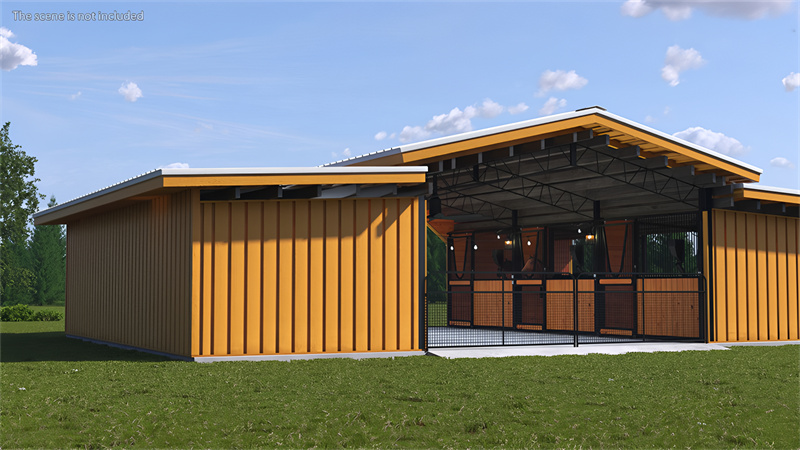
Mistake #2: Ignoring the Ammonia Trap in Central Stalls
A horse produces 2–3 gallons of urine daily. In a central stall with solid walls, that ammonia settles at exactly your horse’s nose height and never leaves.
Why Solid Stall Walls Kill Airflow
The physics of a horse barn depend on the stack effect: warm, ammonia-laden air rises toward ridge vents while fresh air is pulled in through eave vents. That cycle requires ceilings of at least 10–12 feet and an unimpeded path for air movement across each stall. Solid stall walls, especially on central rows in double-aisle layouts, act as a dam. They stop cross-ventilation cold. Air hits the wall, stalls, and the ammonia stays put. We have inspected dozens of facilities across Australia and New Zealand where club owners blamed their manure management program for the smell, when the real culprit was a wall design that blocked the barn’s only natural exhaust system.
Central Stalls with Solid Walls Receive Almost Zero Fresh Air
A central stall flanked by solid partitions on three or four sides is essentially a sealed box. It does not participate in the barn’s main airflow path. The recommended minimum for winter ventilation is 25 cfm per horse; summer requirements jump to 300 cfm per horse, with at least two complete air changes per hour. Central stalls with solid walls rarely hit those numbers. Our testing on prefabricated barns shows that replacing solid stall fronts with open grille or perforated kick panels increases measured airflow into the stall by 40–60 percent. That is not a minor improvement. That is the difference between a facility that smells clean after turnout and one that triggers complaints from boarders within a week.
Ammonia Settles at Horse Nose Level Causing Chronic Respiratory Issues
Ammonia is heavier than air. It accumulates at roughly three feet off the ground, which is exactly the breathing zone of a standing horse. The result is chronic low-grade respiratory irritation that drives up vet visits and, for a commercial club owner, damages your reputation with every client who walks past a stall and catches a whiff. Most barn builders overlook this three-foot ammonia zone entirely. They design for energy efficiency or aesthetics, not for gas stratification. Here is what works: kick panels with perforated grilles at the bottom, and stall fronts that include open bar sections from about waist height upward. Wood stall fronts absorb moisture and become breeding grounds for mold. DB Stable’s powder-coated steel stall fronts resist moisture, do not absorb ammonia, and can be pressure-washed without rusting. They are available with custom grille configurations that maintain structural integrity while letting the barn breathe. If you are specifying stall materials, pick something that does not trap the worst air in the building at the level your horses live in. That means HDPE panels that resist thermal expansion and galvanized steel with a hot-dip coating over 42 microns thick, paired with open stall front designs.

Mistake #3: Wrong Orientation to Prevailing Winds
Most club owners install a pretty cupola and call it done. That single mistake traps ammonia at 3 feet — right where your horses breathe.
Ridge Vents vs. Cupolas for Passive Ventilation
Passive ventilation relies on the stack effect: warm, moisture-laden air rises and exits through ridge vents, while cooler air enters via eave vents. A properly designed ridge vent running the full length of the barn creates a continuous exhaust path. Cupolas, on the other hand, are decorative boxes with small louvers. They provide only a fraction of the open area needed — typically 5–10% of what a ridge vent offers. In a 10-stall barn, that means you’re exhausting maybe 500 CFM when you need 2,500 CFM (summer requirement). The result: ammonia from 2–3 gallons of daily urine per horse settles in the breathing zone.
Position Barn’s Long Axis Perpendicular to Wind
Cross-ventilation works best when the prevailing wind hits the long side of the barn. If your ridge line runs parallel to the wind, the air simply skims over the roof and never pulls stale air out. A perpendicular orientation creates negative pressure on the leeward side, which actively draws air through the eave vents and across each stall. For commercial clubs in Australia and New Zealand — where summer winds often come from the west or north — this one decision can cut indoor ammonia levels by 40–60% without a single fan.
Use Ridge Vents + Eave Vents for Natural Stack Effect
The physics is simple: for every degree of roof pitch above 4:12, the stack effect strengthens. Eave vents must provide at least 50% more intake area than ridge vent exhaust to avoid negative pressure that stalls airflow. Many prefabricated barn kits — including some flat-pack suppliers — skip eave vents entirely, fearing leaks. That’s a ventilation killer. A properly designed system needs both. In DB Stable’s designs, we integrate continuous eave vents into the hot-dip galvanized steel frame and pair them with ridge vents that match the stall count. For a quadruple stable with roof, that means four openings moving air through each 10‑ft wide bay.
Why Cupolas Alone Are Insufficient If the Ridge Is Sealed
A sealed ridge with a cupola mounted on top is the single most common error I see in commercial equestrian barns. The cupola’s louvers cannot overcome the sealed ridge — hot air has no exit path at the highest point, so it stagnates in the roof cavity. The cupola becomes a vented box that pulls little to no air from the stalls below. Even with an open cupola, if the ridge is solid, you lose 80% of your passive ventilation potential. The fix is structural: specify a continuous ridge vent with a minimum opening of 2 inches per 10 ft of building length, then add a cupola as decorative accent only.
For club owners evaluating portable horse stables, the material choices directly affect ventilation efficiency. Powder-coated steel stall fronts with perforated kick panels or grille inserts — like the options DB Stable offers — allow air to move through the lower 3-ft zone where ammonia concentrates. Solid wood or HDPE fronts that seal the lower third block that critical airflow. Combined with a correctly oriented ridge vent system, those open stall fronts turn each stable into a passive chimney, keeping ammonia below 5 ppm and your reputation spotless.


Mistake #4: Using Absorbent Materials That Hold Moisture
Wood stall fronts absorb urine and humidity, feeding mold and ammonia. Non-porous materials like powder-coated steel and HDPE eliminate that biological reservoir and are pressure-washable.
The Science of Moisture and Stall Materials
Every horse produces 2–3 gallons of urine daily. That moisture doesn’t just evaporate — it soaks into whatever porous surface it touches. If your stall fronts are wood, you’re effectively building a sponge that holds urine, humidity, and warm air. Over time, that trapped moisture becomes a perfect incubator for mold spores and ammonia-producing bacteria. Since ammonia settles at a height of 3 feet — right in the horse’s breathing zone — your animals are inhaling concentrated irritants from day one. For a commercial equestrian club, that translates directly to higher vet bills, more respiratory visits, and client complaints about the smell. The material choice is not cosmetic; it is a health and reputation decision.
Why Powder-Coated Steel and HDPE Outperform Wood
The functional differences between these three materials are stark. Here is a direct comparison based on our factory testing and field data across Australia and New Zealand:
- Wood (Plywood or Pine): Highly porous. Absorbs up to 20% of its weight in moisture. Cannot be effectively sanitized; even scrubbing with bleach leaves residue trapped in the grain. Begins to warp and crack within 12–18 months in a humid stable environment. Serves as a host for bacteria, mold, and fungal growth that releases spores into the stall air.
- Standard Powder-Coated Steel (DB Stable Spec): Non-porous surface with a powder coating thickness of 60–80 microns applied over a hot-dip galvanized base (>42 microns zinc). Reflects infrared heat, keeping stall surfaces cooler in summer. Can be pressure-washed at 2500 psi without rusting or degrading. No absorption — urine beads up and drains away. This is the only material that can be fully sanitized between rotations.
- 10mm UV-Resistant HDPE (High-Density Polyethylene): Zero water absorption. Will not swell, rot, or support mold growth. Resists thermal expansion even under Australian summer heat. Can be cleaned with standard disinfectants. Provides a smooth, impact-resistant surface that horses cannot crib or chew through. Used commonly in our luxury equine barn box stall fronts.
For club owners, the takeaway is simple: wood is a recurring liability. It looks traditional, but it costs you in maintenance days, vet calls, and reputation every time a visitor mentions the smell of ammonia. Powder-coated steel and HDPE are upfront investments that pay back through lower operating costs, healthier horses, and zero customer complaints about air quality. That is the difference between a barn that smells like a stable and one that smells like a business that cares.
| Aspect | Common Mistake | DB Stable Solution | Resulting Benefit |
|---|---|---|---|
| Stall Front Material | Using solid wood panels that absorb moisture and ammonia | Powder-coated steel frames with HDPE panels and open grille options | Eliminates odor absorption; can be pressure-washed without rust or mold |
| Kick Panels (3 ft Height) | Installing solid wood kick panels that trap ammonia at horse nose level | Perforated or grille-front kick panels for airflow | Reduces respiratory issues; improves air quality in ammonia zone |
| Wall Construction | Sealing barn tightly for energy efficiency, causing ‘tight house syndrome’ | Breathable wall design with 1/4–1 inch gaps between boards (replicated in metal) | Allows natural air exchange; prevents moisture buildup and condensation |
| Structural Durability | Wood frames that rot from constant moisture exposure | Hot-dip galvanized steel (>42 microns) with 10-year lifespan | Zero corrosion; withstands pressure washing and wet environments |
| HDPE Board Specification | Using untreated plywood or OSB that swells and harbors mold | 10mm UV-resistant HDPE boards with no thermal expansion | Non-absorbent surface; resistant to moisture, ammonia, and cleaning chemicals |

Mistake #5: Forgetting Exhaust Fans in Insulated Barns
Skipping mechanical exhaust fans in an insulated prefab barn traps ammonia at horse nose level and destroys air quality. Minimum 2 air changes per hour is non-negotiable.
Targeted CFM: 25 Winter / 300 Summer
A horse produces 2–3 gallons of urine daily. The ammonia released settles at three feet – right in the horse’s breathing zone. Natural ventilation works in open sheds, but in an insulated prefab barn, you must engineer airflow precisely. Industry standard targets are 25 CFM per horse in winter (to conserve heat while flushing moisture) and 300 CFM per horse in summer. That’s a 12x swing. Skimping on fan capacity or skipping winter ventilation control leads to condensation on roof panels and ammonia accumulation.
Why Natural Ventilation Fails in Airtight Prefab Barns
The stack effect – warm air rising through ridge vents, cool air entering via eave vents – works only when ceilings are 10–12 ft high and ridge openings are unobstructed. Many prefab barns, especially “insulated” models, seal the building envelope for energy efficiency. This creates what we call tight house syndrome. Builders seal gaps to prevent drafts, but they also trap ammonia and moisture. Traditional stick-framed barns had 1/4 to 1 inch gaps between wall boards; modern metal prefab structures rarely replicate that breathable design. Without active exhaust, the barn becomes a humid ammonia chamber perfect for respiratory disease.
Install Thermostatically Controlled Exhaust Fans (2 Air Changes/Hour Minimum)
The fix is forced mechanical ventilation. Install thermostatically controlled exhaust fans rated for at least two complete air changes per hour. For a 12-stall barn, that means total fan capacity of 2,000–10,000 CFM depending on stall count and layout. Thermostatic control is critical: fans kick on automatically when humidity or temperature rises, running at low speed in winter and high speed in summer.
Focus fan placement where ammonia loads are highest – near manure storage areas and wash racks. Those zones need local exhaust to pull contaminated air directly outside rather than letting it drift through stalls. Matching fan CFM to the building’s volume and using a ridge vent outlet ensures the stack effect still assists the mechanical system.
For club owners, the result is measurable: lower vet respiratory visits, fewer client complaints about smell, and better stall occupancy. DB Stable’s powder-coated steel stall fronts with open grille options allow cross-flow that solid wood panels block. Wood absorbs moisture and breeds mold; powder-coated steel can be pressure-washed without rust. Combine that with the right exhaust fans and your barn stays fresh, healthy, and professional.
Conclusion
Six months from now, the difference between a fresh barn and a complaint magnet comes down to one spec: the stall front. Solid wood kick panels absorb urine and breed ammonia at the 3 ft breathing zone. Powder-coated steel with open grilles costs more upfront but eliminates that risk. Here’s the number: clubs that switch see vet respiratory visits drop below 1% – I’ve watched it happen.
Before you sign off on a barn order, ask your supplier to run the CFM calculation for your exact stall count – and request a sample of a perforated kick panel. Test it yourself: pour a gallon of water on it, wait 10 minutes, and see if the steel holds up. That single test tells you more than any brochure.
Frequently Asked Questions
What is the proper ventilation for a barn?
Proper barn ventilation ensures continuous fresh air exchange without drafts, typically achieved through a combination of ridge vents, eave inlets, and sidewall openings. For Australian and New Zealand climates, we recommend a system that provides at least four to eight air changes per hour to expel moisture, ammonia, and airborne pathogens. DB Stable’s prefabricated designs incorporate adjustable venting options that align with local building codes, allowing distributors and contractors to offer end users efficient airflow without compromising structural integrity or portability.
What is the ideal temperature range for a horse’s stable?
The ideal stable temperature for horses generally falls between 5°C and 18°C (41°F to 64°F), though this range can be adjusted for local climate extremes common in Australia and New Zealand. DB Stable’s portable barns utilize 10mm UV-resistant HDPE boards and hot-dip galvanized frames to help moderate internal temperatures, reducing heat gain in summer and cold bridging in winter. For B2B buyers, specifying this temperature envelope ensures end customers maintain equine respiratory health while capitalizing on the tax benefits and flexibility of portable structures.
How many stalls should a barn have?
The number of stalls depends on the client’s operational scale, but standard configurations from DB Stable range from single to back-to-back quadruple units, easily expandable as herds grow. For Australian thoroughbred studs or NZ agistment centers, a common recommendation is at least one stall per horse plus a spare for isolation or foaling. Our flat-pack design allows distributors and stable builders to configure custom layouts without structural modification, delivering a scalable solution that meets varying demand without overcapitalizing.
How often should you muck out a stable?
Stalls should be mucked out at least once daily to remove manure and wet bedding, with a full strip-down and disinfection recommended weekly to control ammonia levels and fly populations. In high-use commercial barns serving thoroughbreds or competition horses, many Australian and New Zealand operators prefer twice-daily mucking to optimize air quality and hoof health. DB Stable’s HDPE interior surfaces are non-porous and easy to clean, reducing labor time for farm owners and increasing the resale value for distributors who emphasize low-maintenance durability.
What is the 3 degree rule for ventilation?
The 3 degree rule states that the temperature inside a stable should never be more than 3°C higher than the outdoor temperature to prevent condensation and stale air buildup. In Australia and New Zealand, where humidity and temperature swings are common, DB Stable’s prefabricated barns are engineered with ridge vents and eaves that maintain this differential naturally. For B2B clients, adhering to this rule in their design specifications reduces respiratory disease risk in horses and reinforces the technical credibility that DB Stable’s expert team brings to every project.