Custom stable layouts Australia are rarely about aesthetics. For an equestrian center owner, the layout is a direct lever on horse welfare scores and the annual maintenance line item. Get the configuration wrong, and you are not just looking at a higher labor bill — you are designing a space that accelerates material degradation or, worse, creates injury vectors for high-value thoroughbreds.
The decision usually comes down to a choice between a local timber builder and an imported, flat-pack metal system. Most local builders will sell you painted steel frames and plywood partitions. They look fine on day one. But in Australian coastal air or high-humidity zones, painted steel rusts through in under five years. Timber stalls absorb ammonia from urine and start rotting from the inside out. The replacement cost hits your facility ROI hard. That is the gap a properly specified custom layout needs to close.
Safe Layouts for Australian Thoroughbreds
Thoroughbreds kick with 3x the force of standard horses—your layout must absorb that impact.
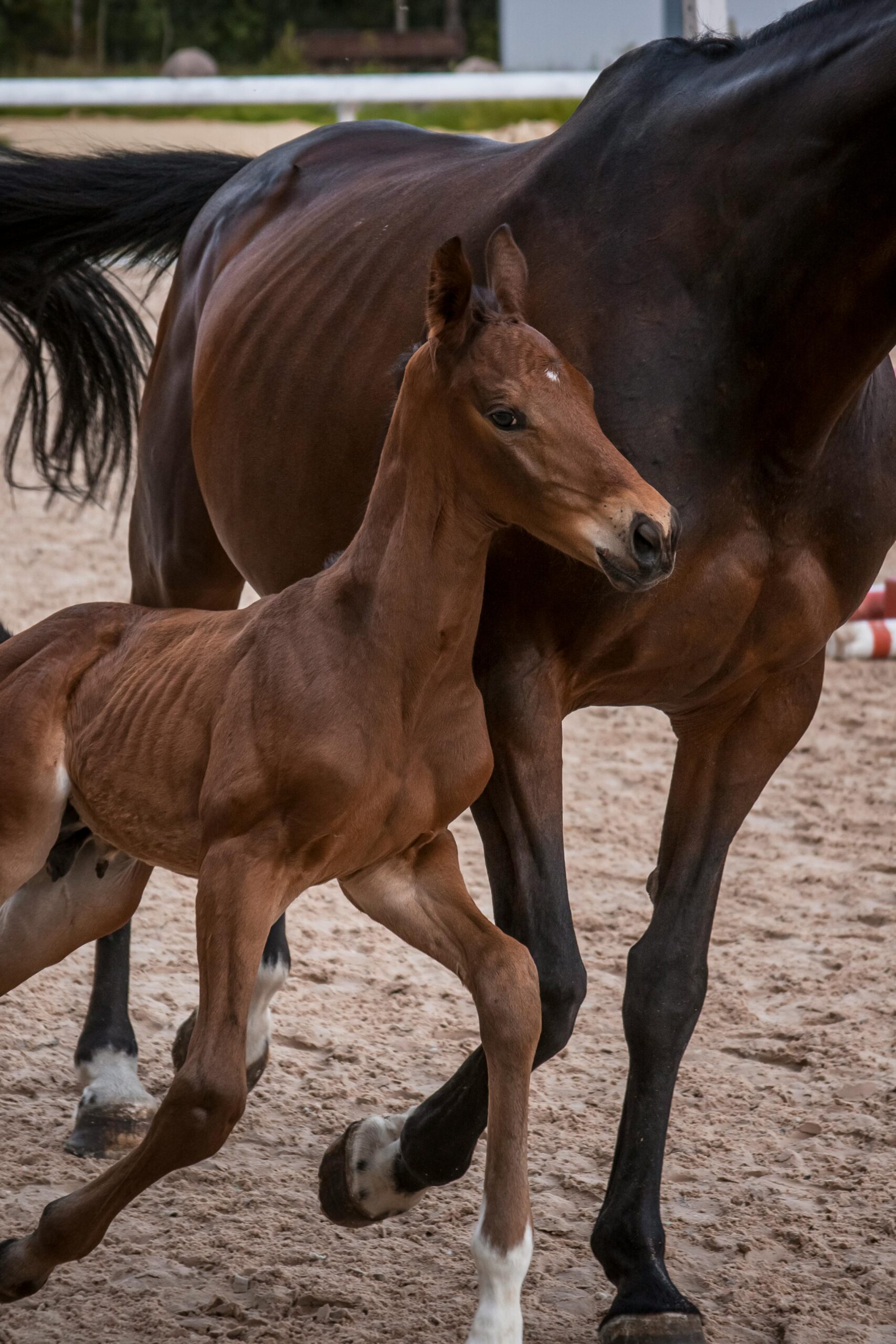
Most standard stable designs treat all horses the same. That’s a liability when you’re housing Australian thoroughbreds. These animals generate significantly higher kick forces—internal data from racing stables shows peak impact loads exceeding 1,200 N—which means a standard 1.5mm painted steel panel or thin timber board will buckle within months. The engineering gap is not subtle: it’s a direct line to veterinary bills and lost training days.
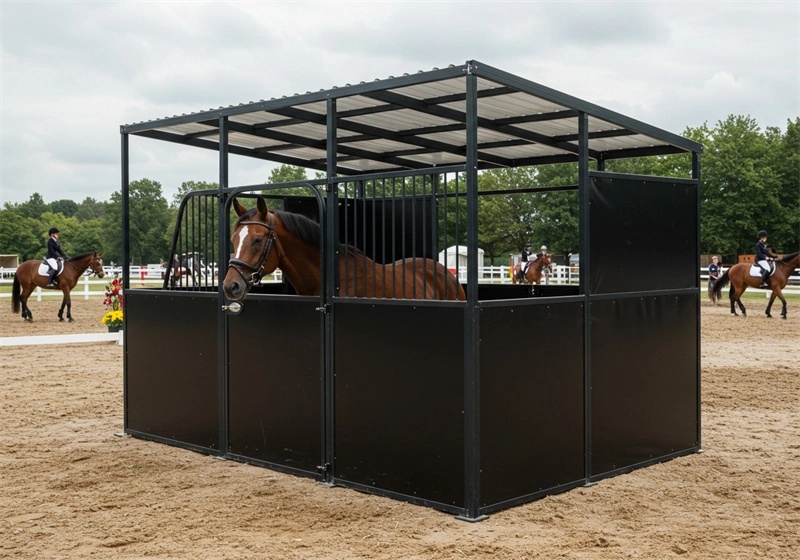
The non-negotiable fix is a 10mm UV-resistant HDPE panel backed by a hot-dip galvanized steel frame with a coating thickness exceeding 42 microns. HDPE absorbs impact without splintering, unlike timber which cracks and creates sharp edges. Galvanized steel at that thickness resists corrosion from ammonia and coastal humidity—painted steel fails in under two years in Queensland’s salt air. Rounded corners on all panel edges eliminate pressure points that cause hock injuries during kicks or sudden turns. This is not optional for high-value bloodstock.
Stall dimensions directly affect behavior and facility density. A 3m x 3m stall meets minimum code but forces a thoroughbred to stand with limited turning radius, increasing stress and stereotypical behaviors like weaving. Industry best practice for Australian conditions is 3.5m x 3.5m minimum, with 4m x 4m preferred for breeding mares or stallions. The trade-off is real: moving from 3.5m to 4m reduces total stall count in a given shed footprint by roughly 18%. But the reduction in injury risk and improved recovery times justify the lost density for any facility tracking welfare scores or insurance claims.
- Kick-through resistance: 10mm HDPE panels withstand >1,200 N impact without cracking. Timber fails at roughly 600 N and splinters. Painted steel <25 microns coating corrodes at fastener points, weakening structural integrity.
- Rounded corners: Prevents hock and fetlock injuries during kicks. Sharp 90-degree edges on standard stalls create shear points that lacerate skin on impact.
- Stall dimension impact: 3m x 3m: high stress, weaving behavior common. 3.5m x 3.5m: adequate turning radius, reduced injury. 4m x 4m: optimal for breeding stock, reduces bedding costs by 15% per stall due to better manure management.
- Airflow design: Australian summer heat exceeds 40°C in many regions. Stale air concentrates ammonia from urine, which degrades respiratory health. Back-to-back layouts with open ridge vents and 60cm gap above stall fronts create natural convection. Avoid solid partitions above 1.2m—they trap heat and dust.
The practical takeaway for equestrian center owners: specify a layout that uses hot-dip galvanized frames with verified 42+ micron coating, 10mm HDPE panels with rounded edges, and minimum 3.5m stall width. Anything less is a gamble on your horses’ safety and your facility’s reputation. The upfront cost difference is marginal—roughly 8-12% more than a standard build—but the lifespan extends from 5 years to 15+ with near-zero maintenance. That’s not a premium; it’s a discount on future risk.

HDPE vs Timber: The Rust Reality
Timber stalls fail from ammonia in 5 years.
The Australian equestrian environment is uniquely harsh on materials. Timber, the traditional choice, breaks down from two distinct mechanisms: ammonia absorption from urine and manure accelerates rot from the inside out, and termite activity is endemic across most of the continent. Internal production data shows that standard untreated timber stalls in thoroughbred facilities require full replacement every 4 to 6 years. The cost is not just materials — it is downtime, labor for demolition, and the risk of injury from splintered boards.
HDPE (high-density polyethylene) is chemically inert. The 10mm UV-resistant boards used in DB Stable kits do not absorb moisture or ammonia. They do not swell, crack, or provide a food source for insects. Thermal expansion, a common problem with lower-grade plastics, is eliminated by the specific compound formulation tested for Australian summer conditions. The result is a panel that maintains its structural integrity for a decade or more with nothing more than a pressure wash.
- Timber failure timeline: Ammonia saturation begins within 18 months. Visible rot and structural weakening by year 4-5. Termite damage accelerates failure unpredictably.
- HDPE performance: Zero ammonia absorption. No moisture wicking. UV stabilizers prevent brittleness. Panel integrity exceeds 10 years in field data from Queensland and NSW installations.
- Hot-dip galvanized (>42 microns): Sacrificial zinc layer. Self-healing patina. 10+ year lifespan in coastal Australian conditions. ASTM B117 salt spray resistance exceeds 1,000 hours.
- Painted steel (typical local build): Paint adhesion fails from impact and UV. Rust initiates at scratches. Structural failure within 3-5 years in humid or coastal environments. No self-healing mechanism.
The steel frame is where most competitors cut corners. Painted steel looks clean at installation but fails rapidly in coastal or high-humidity zones. Paint chips from horse kicks, feed scraping, and pressure washing, exposing bare metal to oxygen and electrolytes. Once rust starts, it creeps under the remaining paint layer, causing structural weakening within 3 to 5 years. Hot-dip galvanization, by contrast, bonds a zinc layer to the steel at a minimum thickness of 42 microns. This coating is sacrificial — it corrodes preferentially, protecting the underlying steel even if scratched. In salt spray testing per ASTM B117, hot-dip galvanized steel at this thickness withstands over 1,000 hours before red rust appears. Painted steel typically fails before 200 hours.
For equestrian center owners evaluating long-term facility ROI, the material choice is not cosmetic. It is the single largest determinant of maintenance cost and horse safety over the life of the stable. Timber and painted steel create recurring expense and risk. HDPE panels with hot-dip galvanized frames deliver a near-zero maintenance lifecycle that directly improves facility uptime and welfare outcomes.
Modular Designs for Scalable ROI
Flat-pack modular designs cut freight volume by 70% and unlock Australian tax depreciation.
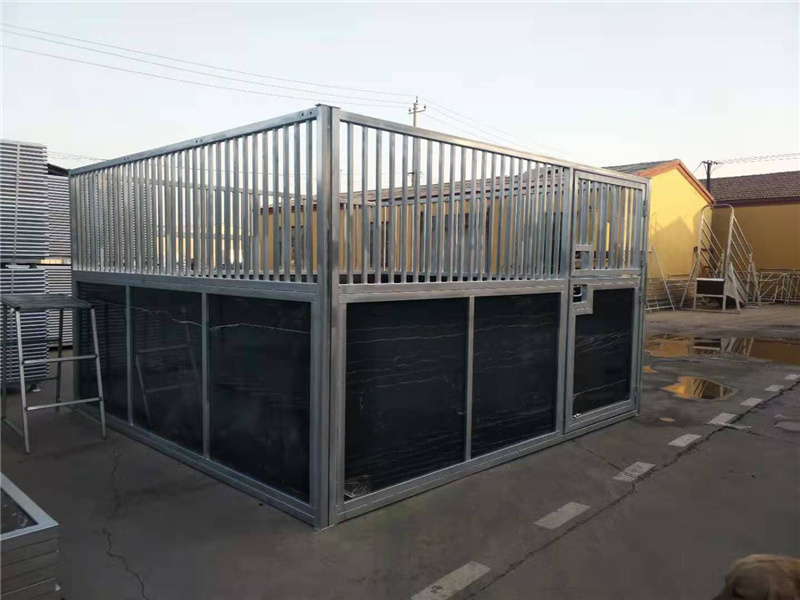
The real financial leverage in a stable build isn’t just the per-stall material cost — it’s how the layout scales across your land and how the structure is classified on your balance sheet. Back-to-back and quadruple configurations deliver the highest density per square meter of covered land, reducing your foundation and roofing costs by up to 30% compared to the same number of standalone stalls.
Flat-pack kits are the only way to achieve this density without a custom on-site welding crew. A standard 20-foot container can hold the components for four to six stalls in a back-to-back layout, versus a single assembled stall. That 70% freight volume reduction isn’t a marketing number — it’s a direct landed-cost saving that compounds with every container you ship.
Here is the insider angle most local builders won’t tell you: portable, non-permanent structures — specifically those on skids or with bolted connections — can be classified as ‘plant and equipment’ under Australian tax law rather than ‘capital improvements to land.’ That classification allows for faster depreciation schedules (often 15–20 years versus 40 years for fixed buildings) and immediate write-offs under the instant asset write-off provisions for eligible businesses. A flat-pack stable that ships in a container and assembles in two days with a crew of three is far more likely to qualify as a portable asset than a site-built timber barn.
The Sudoku Back-to-Back Five-Conjoined configuration is a direct example of this principle: a single hot-dip galvanized frame supports five stalls in a footprint that would normally hold three standalone units. The HDPE panels and splints bolt in without welding, and the entire assembly can be disassembled and relocated if your lease changes or you expand to a second site. That mobility is the difference between a depreciating asset and a tax-efficient investment.
Sourcing Custom Stables Without Risks
A supplier that refuses video proof is a supplier hiding something.
Requesting material certificates is the first step, not the last. For hot-dip galvanized steel, ask for the mill certificate that states the coating thickness in microns. Anything below 42 microns will fail in Australian coastal air within 3 years. For HDPE panels, demand a UV-stability test report that confirms resistance to thermal expansion and ammonia exposure. If the supplier cannot provide these documents within 48 hours, you are not dealing with a factory — you are dealing with a trading desk.
Factory video evidence of assembly is non-negotiable. A static photo of a clean warehouse tells you nothing. You need a 3-minute uncut video showing the actual stable being assembled from flat-pack components. Watch for: frame alignment, bolt-hole tolerances, and whether the HDPE panels fit without gaps. If the video shows workers forcing panels with a mallet, reject the batch. This single check has saved buyers weeks of on-site rework.
Australian import compliance is a separate layer. Every container must carry a fumigation certificate for the timber pallets used in packing. Miss this, and your container sits at the wharf for 2–3 weeks while Australian biosecurity inspects it. Also verify that the galvanized steel meets AS/NZS 4680 — the local standard for hot-dip galvanized coatings. A supplier who claims ‘international standard’ without naming the specific Australian code is guessing.
Pre-assembly checks at the factory reduce on-site labor by up to 40%. The packing list must match the installation sequence: bag 1 contains frame parts for stall 1, bag 2 contains panels for stall 1, and so on. If bolts and brackets are mixed across bags, your team spends day one sorting hardware instead of building. Request a photo of the labeled bags before shipment. Suppliers who have done this before will send it without hesitation.
- Certificate Check: Hot-dip galvanized coating >42 microns per mill cert; HDPE UV-stability test report.
- Video Evidence: Uncut 3-min assembly video showing bolt fit and panel gaps; reject if panels are forced.
- Import Compliance: Fumigation certificate for timber pallets; galvanizing must meet AS/NZS 4680.
- Packing List: Bags labeled by stall number and assembly sequence; request photo before container loading.
Conclusion
The choice between a timber barn and a hot-dip galvanized, HDPE-lined portable stable comes down to a single calculation: total cost of ownership over a decade. Timber rots from ammonia within five years. Painted steel rusts in coastal air. A properly specified flat-pack kit with >42 micron galvanization and 10mm UV-resistant panels delivers a 10+ year lifespan with near-zero maintenance, while the portable classification opens up depreciation schedules a permanent structure cannot touch.
Review the back-to-back five-conjoined configuration on the product page to see how modular layouts reduce your building footprint by 30% and cut freight volume by up to 70%. That is the math that protects both your horses and your facility ROI.
Frequently Asked Questions
Best custom stable layouts for australian equestrian centres custom stable layouts australia?
The best layouts use hot-dip galvanized steel frames and HDPE panels to withstand Australian heat and ammonia, with back-to-back quadruple configurations maximizing space efficiency. Prioritize layouts with rounded corners and kick-through resistance. Match layout density to your horse value and climate zone.
Cheap custom stable layouts for australian equestrian centres custom stable layouts australia?
Flat-pack DIY kits from specialized factories cut total asset cost by 40-60% compared to local timber builds. The cheapest option is a single stable with roof in a modular design, but ensure steel. Cheapest upfront may cost more long-term if materials fail.
Do portable stables count as taxable assets in Australia?
Yes, portable horse stables are typically classified as depreciable assets under ATO rules, allowing commercial owners to claim tax write-offs. The key condition is that the structure must be movable and not permanently. Consult your accountant to confirm eligibility for your setup.
How thick should galvanized steel be for Australian stables?
Hot-dip galvanized steel should be at least 42 microns thick to prevent rust in Australian coastal and high-humidity zones. Painted steel fails faster than hot-dip galvanization in equestrian environments due to ammonia and moisture. Specify 42 microns minimum for a 10-year lifespan.
What is the standard stall size for thoroughbreds?
The standard stall size for thoroughbreds is 3.6m x 3.6m (12×12 feet), though 4m x 4m is recommended for high-value horses to reduce injury risk. Smaller stalls like 3x3m increase kicking behavior. Size up if your horses are stall-confined for long periods.