The 30% figure came from a New Zealand builder who moved a custom HDPE stable order onto a factory-direct route. It is recorded on this site in a July 2026 case study, and it is what importers quote back when factory direct stable savings come up in a negotiation.
What that headline cannot tell the next buyer is where inside the deal the money was taken out. This wrap pulls it into three layers: the selling margin between the works and the yard, buying to published module sizes against commissioning bespoke fabrication, and the shape of the freight. Two of those transfer to your order. One does not.
Key Takeaways
- Recorded result: one New Zealand builder cut custom stable cost by 30% by switching to a factory-direct HDPE order, as published on this site in July 2026.
- Repeatable: sizing the block to standard panels — 2844×1194×10 mm or 3494×1194×10 mm HDPE sheet in a fully welded 50×50×2.0 mm frame — instead of non-standard cuts.
- Also repeatable: the shared-wall arithmetic in the official configuration table, where six bays back-to-back are built with 11 side panels and 6 gates.
- Not repeatable: the reseller margin and drafting cost between that builder and his old route. Those belong to his market and his negotiation.
- The clause worth having in writing is the coating statement: a factory specification of 42 microns or more, with the galvanising process executed to AS/NZS 4680.
- Not published in this category, so confirm in writing before you bank a saving: trade terms, payment arrangements, bulk production lead time and certificate numbers.
What the case record says
The project is documented rather than remembered. A builder in New Zealand, HDPE panel walls, a custom stable order, and a recorded 30% cut against the route he had been quoting through. The write-up attributes the gap to two causes: taking the local distributor’s margin out of the panel package, and getting design support from the factory rather than paying for it locally. The original record is here on this site.
Read that closely, because it is the whole problem with case numbers. Two causes are named and neither carries a percentage. Anyone who tells you 18 points came from the distributor and 12 from design support is inventing arithmetic. The record does not split it.
The test is whether each cause has a visible mechanism in published information. Three do, and they behave differently on your next order.
Layer one: the selling margin
The supplier here sells as a manufacturer and exporter into Australia and New Zealand, not as a shopfront. That removes one commercial layer between the works and your yard, which is where the recorded saving started. It also puts the technical conversation in front of the people who cut the tube.
Two published service commitments show what that means in practice: enquiries answered within six hours, and quotes built from drawings returned within 24. A buyer who sends a layout sketch or a reference photo gets a costed structure the same day rather than waiting on a reply routed through the supply chain. Third-party inspection can be carried out in plant, with reports and test documents on request.
Be straight about what this layer does not do. It does not move the price of steel or zinc, and it does not dissolve a 10-set minimum order. A factory quote that lands above your current delivered cost is a quote, not a saving. How that margin sits on the reseller side is worked through in the New Zealand margin management case wrap.
Layer two: module sizes against bespoke work
This is the repeatable layer, and it is geometry. Published panel sizes are 2844×1194×10 mm and 3494×1194×10 mm HDPE sheet, framed in 50×50×2.0 mm square tube, fully welded, with 4.0 mm wire at 50×50 mm mesh and about 200 kg per finished panel, confirmed on the drawing. Height is 2200 mm, with stall lengths of 3000 mm and 3600 mm and front widths of 1150 mm or 1300 mm.
A buyer who sizes a block to those numbers is buying production parts. A buyer who asks for an odd bay depth asks the works to re-cut, re-weld and re-plan a run, and pays for it inside a line item he never sees. Custom is offered here — that is what the 24-hour drawing quote is for — but custom layout and custom fabrication are different costs, and the first is close to free once the second is avoided.
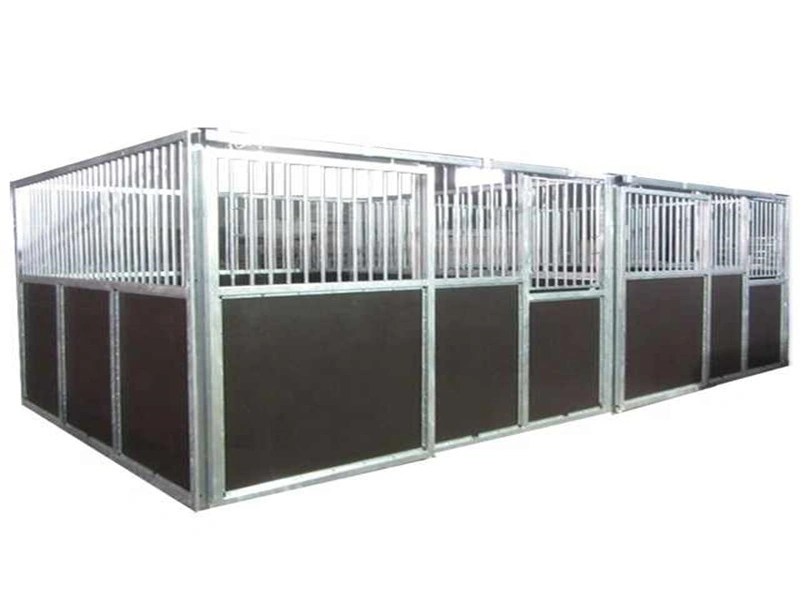
Then there is the wall you do not buy twice. The official configuration table counts side panels and gates per layout, and the arithmetic is the saving.
| Layout | Side panels | Gates | Panels per bay |
|---|---|---|---|
| 1 bay | 3 | 1 | 3.00 |
| 2 bays adjacent | 5 | 2 | 2.50 |
| 3 bays | 7 | 3 | 2.33 |
| 4 bays | 9 | 4 | 2.25 |
| 5 bays | 11 | 5 | 2.20 |
| 6 bays back-to-back | 11 | 6 | 1.83 |
Three bays on a row cost seven side panels and three gates. A fourth bay adds two panels and one gate. The six-bay back-to-back block then gives a whole wall to a shared divider: eleven panels and six gates, one more bay than the five-bay row for no extra panel. Ordering to that shape is among the cheapest structural decisions available in this product, and it costs nothing to ask for. The same panel arithmetic is what drives block scaling in the panel count scaling case wrap.
Layer three: freight, coating and the queue
The third layer travels. Flat pack exists because a welded stable is mostly air otherwise, and lowering the volume each set occupies is what makes an ocean consignment to Australia or New Zealand worth sending. That is how a delivered cost can fall even when the ex-works figure does not move.

Air freight is offered for urgent items at extra cost, which makes it a valve for a missing gate or a damaged panel rather than a supply route. Coating is where a saving gets promised and then quietly withdrawn. The wording to insist on is a factory specification of 42 microns or more with the galvanising process executed to AS/NZS 4680. Read that as two statements rather than one ranking: a works commitment on the coating, and a standard governing the process. The standard’s own minimum for steel in the 1.5-3 mm wall range is 45 microns local and 55 microns average, and neither figure should be swapped for the other.
Then the queue, because a discount that lands eight weeks late is not a discount. Stated output is about 20 sets a week against a minimum order of 10 sets, so one order at the minimum occupies roughly half a week of production. Volume, price ladder and delivery date are the same conversation, not three.
What the case cannot hand over is the paperwork underneath it. Trade terms, payment arrangement, bulk production lead time and certificate numbers behind that 30% are not published. Treat the project as evidence that the route works, and your own written confirmation as evidence of what it costs you. The portable horse stable range is published at standard sizes for that reason.
Frequently Asked Questions
Is 30% a realistic factory-direct target?
It is a recorded result, not a benchmark. The figure comes from one New Zealand builder’s switch in one market, published on this site in July 2026. Judge your own quote against your current delivered cost, line by line, rather than against someone else’s percentage.
Which part of a saving can be verified before payment?
The specification. Ten millimetre HDPE sheet, a 50×50×2.0 mm fully welded frame, 4.0 mm wire at 50×50 mm mesh, and a coating stated as 42 microns or more with the process run to AS/NZS 4680 are all countable on a drawing. Margin claims are not.
Does the 10-set minimum change what I save?
It changes what you are competing for. The published minimum is 10 sets against stated output of about 20 sets a week, so one order at the minimum takes roughly half a week of capacity. Ask for the price ladder and the production slot it assumes in the same reply.
What must be in writing before I sign?
Trade terms, payment schedule, bulk production lead time, the coating statement as a factory specification, and what the third-party inspection report actually covers. Certificate numbers are not published, so any tender relying on them needs the original document.
Conclusion
Three mechanisms behind the recorded saving are structural and do transfer: published module sizes, shared-wall panel counts and flat pack freight volume. The size of a reseller margin in someone else’s market does not. The mechanism is reproducible; the percentage is yours to negotiate.
Send your layout priced at standard panel sizes, and put the coating statement in writing before you compare two quotes. That is how you find out whether the 30% is a route or just a number.