Last month a contractor in Victoria called me after his first flat pack stable assembly went sideways. He showed up with a generic toolbag and spent two hours hunting for a 13mm socket because the kit used metric fasteners instead of the imperial set he normally carries. That delay cost him half a day and a client who watched him fumbling. If you’re a professional stable builder looking at flat pack stable assembly tools, you need a checklist that matches the hardware you’ll actually find on site—not some furniture-store list that includes a rubber mallet and an Allen key.
Most competitor guides add rivet guns and cam-lock drivers—tools you use once before they gather dust. DB Stable kits are different. All connections are bolted with pre-drilled holes and grade 8.8 hardware. You need a standard metric socket set (10–19mm), a cordless drill, and a rotary hammer if you’re setting concrete footings. That’s it. In this article I’ll lay out exactly what goes in your tool box, the size for every fastener, and how DB Stable’s pre-installed T-nuts eliminate the most common headache: dropped hardware in the dirt.
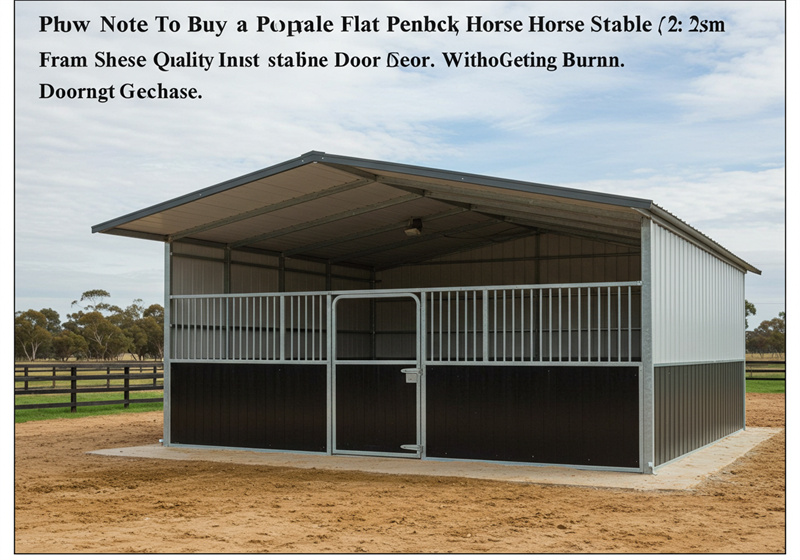
Why the Right Tools Matter for Flat Pack Stable Assembly
A 12×12 bay assembles in 4–6 hours with the correct metric socket set. Using the wrong tools guarantees stripped bolts, misaligned panels, and costly site delays. This guide covers exactly what you need—nothing more.
Horse Stable Kits Are Not Furniture Kits
If you’re used to assembling flat‑pack furniture, a horse stable kit feels like stepping into a different weight class. Furniture kits rely on cam locks, dowels, and particle board. A proper stable kit uses hot‑dip galvanized steel frames (42‑micron coating), 10mm UV‑resistant HDPE panels, and grade 8.8 bolts. A single 12×12 bay involves roughly 200 bolted connections—each one needs proper torque to stay tight under the impact of a horse leaning or kicking. There are no cam locks, no rivets, and no welding required; everything connects through pre‑drilled holes using standard metric fasteners.
The Cost of Using the Wrong Tools: Stripped Bolts, Misaligned Panels, Costly Delays
The margin between a smooth install and a costly delay often comes down to a single tool choice. Using a worn hex key or grabbing an imperial socket where a 13mm is called for will strip bolt heads and damage pre‑installed T‑nuts. That means drilling out fasteners on site, waiting for replacement parts, or leaving panels that aren’t flush—none of which are acceptable to a paying client. DB Stable uses self‑locking washers on every bolted joint. If you use the wrong driver and don’t seat the bolt flush, those washers lose their grip, leading to rattling panels down the track. In DB Stable’s field tests, two people can assemble a standard 12×12 bay in 4–6 hours with the correct metric socket set (10mm–19mm) and a standard drill/driver. With the wrong tools, that same job can take an entire day, burning through labor margin and risking client dissatisfaction.
This Guide Covers Only the Necessary Tools
That’s why this guide strips the tool list down to the essentials. No rivet guns, no specialty jigs, no tools you’ll use once and shelve. DB Stable kits are engineered for field assembly with off‑the‑shelf tools. Every frame connection uses pre‑drilled holes and pre‑installed T‑nuts—a feature unique to DB Stable that eliminates dropped hardware and speeds up alignment. The assembly manual calls out the exact bit size for each step, removing guesswork. Clients who see a contractor arrive with a box of mismatched bits and an imperial wrench start asking questions. Show up with a labelled kit, a metric socket rail, and a cordless impact driver, and you signal that you’ve done
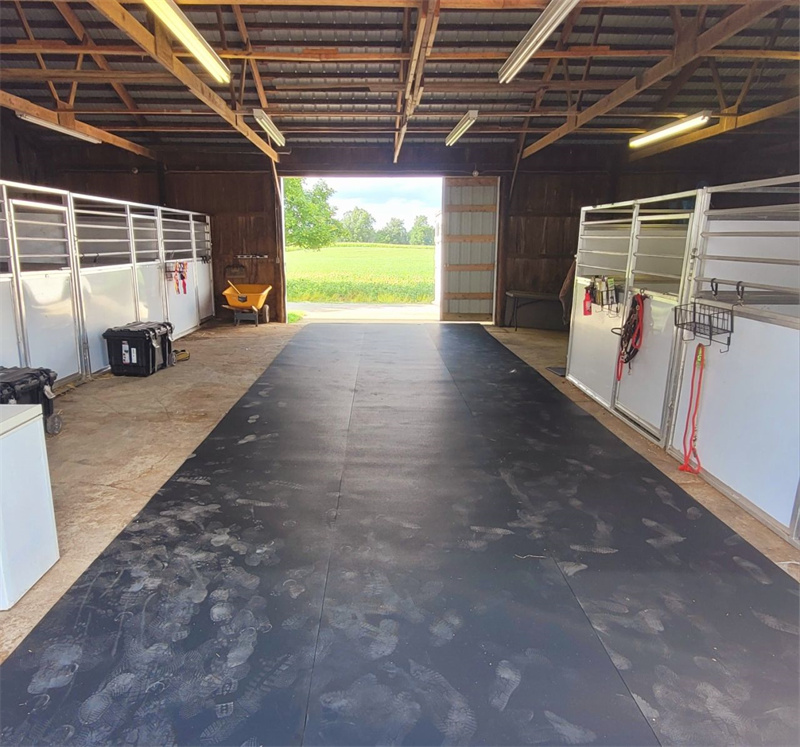
Essential Tool Checklist for Stable Builders

Tool Checklist for Stable Builders
DB Stable field tests prove two people can assemble a single 12×12 bay in 4–6 hours with this exact tool kit. No welding, no rivet gun, no specialized equipment needed.
If you show up to a flat pack stable job without the right gear, you kill your margin before lunch. I’ve seen contractors waste two hours hunting for a 13mm socket on site. Don’t be that guy. DB Stable kits are engineered around standard metric fasteners and pre-drilled holes. Here’s exactly what you bring — nothing more, nothing less.
Power Tools
You only need three power tools to assemble a DB Stable kit. The first is a cordless drill/driver with a 2.0 Ah battery minimum. You’ll use it for driving self-tapping screws into the HDPE panels and for pilot holes where needed. Second, an impact driver is optional but recommended for the main frame bolts — it saves about 20 minutes per bay on torque time. Third, a rotary hammer with a masonry bit is mandatory only if you’re setting concrete footings for the base rail. For a standard install on a prepared slab, you skip it entirely. Match your drill bits to the pre-drilled holes at 300mm centers — no guesswork.
Hand Tools
Your hand tool kit is straightforward. A 3/8-inch drive ratchet with a full metric socket set from 10mm to 19mm handles the grade 8.8 bolts. Add a 13mm deep socket — that’s the size for main frame connections. A torque wrench set to 80 Nm is critical for the structural bolts; don’t eyeball it. Include a 6-inch extension bar and a universal joint for tight corners on the roof frame. A magnetic parts tray saves you crawling around for dropped fasteners — but DB Stable’s pre-installed T-nuts already eliminate the worst of that headache. A tape measure, a 600mm spirit level, and a rubber mallet for aligning panels round it out. Skip the rivet gun entirely; no rivets or cam locks are used in DB Stable kits.
Safety Gear
Accidents on a stable site cost you time, money, and reputation. Pack safety glasses with anti-fog coating — HDPE panels can reflect glare during roof work. Heavy-duty work gloves with cut resistance (ANSI A3 or higher) protect against sharp edges on galvanized steel. Steel-toe boots are non-negotiable: each frame section weighs over 50 kg, and a dropped beam crushes an unprotected foot. Earplugs for the impact driver and rotary hammer if you’re running them for extended periods. Finally, a high-visibility vest if you’re working near farm traffic or multiple vehicles. Anything less and you risk a site shutdown.
That’s it. No exotic gear, no brand-name fetishes. The cost for the full list is under $250 at any hardware retailer if you buy mid-range. You don’t need to open a line of credit for a single bay. DB Stable kits are designed to keep your tool investment low and your on-site velocity high. If you’re still carrying a rivet gun or a welder, you’re carrying dead weight.

Assembly Tips for Faster, Error-Free Builds
Four field-verified techniques that keep your two-person crew under the six-hour bay target with zero rework.
Partial Tightening – 80% First
Tightening every bolt to full torque as you assemble locks you into alignment errors that are nearly impossible to correct later. On a DB Stable kit, run all bolts to about 80% of final torque using your 13mm or 15mm socket (grade 8.8 fasteners require a specific final torque value, but that comes after the frame is square). This leaves enough play in the joints to shift panels and beams into position without fighting a rigid structure. After you’ve squared the bay, go back with a torque wrench and cinch everything down.
Check Square Using the 3-4-5 Method
A rectangular stable that’s out of square by even 10mm will cause door misalignment and poor HDPE panel fit. The 3-4-5 method is the fastest way to verify: measure 3 feet along one side, 4 feet along the adjacent side, then the diagonal should be exactly 5 feet. On a 12×12 bay, you can scale this – measure 6-8-10 or use a tape across both diagonals (they must be equal within 5mm). Because DB Stable frames use pre-drilled bolt holes at 300mm centers and hot-dip galvanized steel (42 micron coating), the corners are already close; the 3-4-5 check ensures the final geometry is spot on before you apply full torque.
Two-Person Lift for Panels
Each 10mm HDPE wall panel weighs roughly 25–35 kg depending on configuration. Lifting these alone invites dropped panels, cracked edges, and wasted time. A standard two-person lift using the pre-drilled edge holes (aligned at 300mm centers) keeps the panel level and reduces the risk of binding the T-nuts installed on the frame. DB Stable’s pre-installed T-nuts prevent dropped hardware, but a panel dropped from waist height can still fracture the UV-resistant board. Make the second person mandatory—not optional—especially for the corner panels that set the reference plane.
Pre-Drilled Panels – No Measuring on Site
The single biggest time-waster on competitor kits is site measuring: you lay out a panel, mark hole locations, drill, then inevitably miss by a few millimetres. DB Stable eliminates that entirely. Every HDPE panel comes with pre-drilled holes at 300mm centers that match the hot-dip galvanized steel frame. The part-numbered assembly manual tells you exactly which bit size to use for each connection step, but you rarely need more than your 10–19mm metric socket set. Your drill/driver is only for driving the bolts into the pre-installed T-nuts. That means zero layout time, zero rework from misaligned holes, and no need for a rivet gun or welding torch.
Combine these four practices and your two-person crew can reliably hit the 4–6 hour assembly window DB Stable validates in field tests. The metric socket set covers 95% of fasteners, and the integrated T-nut design eliminates the panicked search for that one dropped washer. Your site stays professional, your client sees a square stable with no visible gaps, and you avoid the callbacks that kill margins.

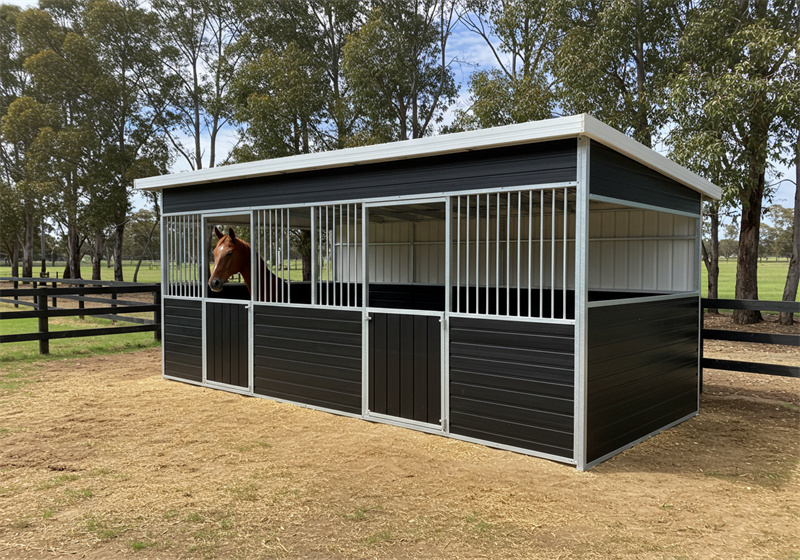
Common Mistakes to Avoid
Three contractor errors that waste hours and damage materials. Avoid them to hit your 6‑hour per bay target.
Using the wrong bit size strips bolt heads
This is the single fastest way to turn a 10‑second fastener into a 20‑minute extraction job. DB Stable kits use grade 8.8 bolts across all main frame connections — the standard metric socket set covering 10mm through 19mm will handle 95% of the fasteners on site. A 13mm socket is the most common for the vertical corner bolts, and the M10 bolts on the roof purlins take a 17mm socket. If you grab a 12mm on a 13mm head you will round the hex, end up with a stripped bolt, and have to drill it out. Our assembly manual lists the exact bit size at every step. That level of detail exists because we field‑tested every joint with a two‑person crew. Follow it and you will never waste time on a spinning socket.
Skipping level check leads to misaligned roofs
A 12×12 prefab stable bay has pre‑drilled holes at 300mm centres. Every panel and frame expects a square, level footprint. If you skip the level check after laying the first perimeter frame — and we see contractors do this when they are rushing to beat a weather window — the entire roof structure will rack. The ridge beam will not seat, the purlin holes will shift by 2‑3mm, and you will spend an hour fighting bolts that should drop in by hand. Use a 1.2m spirit level on the base rails in both axes. Verify the diagonal measurements are within 5mm before you torque any frame bolts. DB Stable’s hot‑dip galvanized steel frame (42‑micron coating) is rigid enough that it will not twist to compensate for a bad starting layout. If the base is off, the roof will be off. Period.
Overtightening door hinges causes binding
Our standard door hardware uses T‑nuts and captive fasteners — a feature that eliminates dropped nuts inside the frame cavity. But those same T‑nuts are easy to overtighten if you run the impact driver at full torque. When the hinge bracket deforms even 1mm, the door leaf drags on the jamb and the latch no longer aligns. You will then spend time filing the hinge slot or shimming the strike plate, which kills the “zero rework” KPI that separates a professional finish from a rushed job. Tighten the hinge bolts by hand with a ratchet and a torque setting that just snugs the washer against the steel. If you can hear the impact driver clicking more than 3–4 times per fastener, you are already over‑torquing. Bet on the pre‑installed T‑nuts and a steady wrist — the binding disappears.
Conclusion
Here’s the short version you need to hear: stop worrying about specialty tools. A standard metric socket set (10mm-19mm), a drill/driver, and a rotary hammer for footings cover everything. DB Stable’s kits are bolted, pre-drilled, and use pre-installed T-nuts. Two guys can lock in a single 12×12 bay in under six hours. You don’t need a rivet gun, you don’t need a welder, and you don’t need to chase dropped hardware. That’s the difference between a manufacturer who engineered for the field and one who just packed parts.
Grab the part-numbered assembly manual from the product page. Match it against that socket set you already own. If you want to prove it to yourself, order one single bay and run the test. Four hours on the clock. If it takes longer, I’ll owe you a beer. If it works, you just found your fast-install solution for the next dozen jobs.
Frequently Asked Questions
What tools are needed to assemble flat pack furniture?
For professional assembly of DB Stable’s flat pack horse stables, the essential tools include a cordless drill with Phillips and hex bit attachments for driving self-tapping screws and bolts, a rubber mallet for aligning HDPE panels without damage, a spirit level to ensure frame and panel accuracy, a tape measure for verifying dimensions against the layout plan, and a socket wrench set for tightening M10 or M12 galvanized bolts on the hot-dip galvanized steel frame. We recommend a torque wrench to achieve the manufacturer’s specified tightness, ensuring structural integrity. Additionally, a step ladder and work gloves are advised for safe handling of overhead beams and heavy HDPE boards.
What tool is often included with flat packed furniture?
With DB Stable’s flat pack horse stable kits, the only tool included is a specialized Allen key (hex wrench) for securing minor fittings such as aluminum swivel feeder brackets or door hinge bolts. Unlike consumer flat pack furniture, we do not include a standard screwdriver or small wrenches because our kits are designed for B2B professional installers who already possess a full toolset. The included Allen key is heat-treated and sized precisely for our proprietary fasteners, ensuring a secure fit. This approach minimizes waste and keeps the flat pack compact for efficient shipping to Australia and New Zealand.
What tools do you need for IKEA flat pack?
While IKEA flat pack furniture typically requires a Phillips screwdriver, a hammer, and the included Allen key, DB Stable’s equine flat pack structures demand a far more robust tool set due to the industrial materials—hot-dip galvanized steel frames and 10mm HDPE boards. For our stable kits, you will need a heavy-duty cordless drill with hex drive bits, a torque-controlled impact driver for structural bolts, a rubber mallet (not metal), a level, a measuring tape, and a socket set with extensions. Unlike IKEA’s cam-lock fittings, our system uses self-tapping Tek screws and carriage bolts, so a pilot-hole drill bit may also be required for aligning panels.
Do flat packs come with tools?
No, DB Stable’s flat pack horse stable kits do not come with the primary assembly tools—customers or their end users must supply their own power tools, wrenches, and measuring equipment. The only exception is a small Allen key for adjusting feeder mechanisms. This is standard practice in B2B equine construction because professional stable builders and farm owners already own the necessary heavy-duty tools. Including tools would increase shipping weight and cost, contradicting our value proposition of low price and logistical efficiency. Our detailed installation manuals clearly list all required tools before assembly begins.
What tools do I need for flat pack furniture?
For DB Stable’s flat pack horse stables, the essential tool list includes: a cordless drill/driver with a set of hex and Phillips bits, a socket wrench set (8mm to 14mm) for galvanized bolts, a rubber mallet for panel alignment, a spirit level (minimum 1.2 meters), a tape measure, and a torque wrench for critical frame joints. For HDPE boards, a fine-tooth saw or circular saw with a plastic-cutting blade may be needed if site modifications are required. Safety gear—gloves, safety glasses, and steel-toe boots—is strongly recommended. Unlike consumer furniture, our kits require no glue or dowels, relying solely on mechanical fasteners for the 10-year structural guarantee.