Most distributors focus on landed cost and margin. They miss the real lever: portable stable tax depreciation. The difference between a 2.5% write-off and a 25% write-off isn’t accounting theory. It’s cash flow that decides whether a company reorders next quarter or sits on inventory.
The ATO draws a hard line under ruling TD 97/24. Bolt a stable to a concrete slab and it’s Capital Works — 2.5% straight line, every year, for decades. Keep it demountable, keep it on the ground with no permanent foundation, and it qualifies as Plant and Equipment. That unlocks 25% diminishing value depreciation and access to the Instant Asset Write-Off, which can wipe out $20,000 to $30,000 of taxable income in Year 1. For a commercial buyer moving multiple units, that math changes the entire project ROI.
Here’s where the engineering meets the tax schedule. The effective life of a steel stable depends on how fast it degrades. Hot-dip galvanized steel with a 42-micron zinc coating holds its value for 10 to 20 years. Inferior materials — painted steel that rusts, timber that rots, thin HDPE that warps — trigger impairment losses. That complicates the depreciation claim and eats into the very tax benefit you’re trying to capture. The material spec isn’t just a quality issue. It’s a tax-asset protection strategy.
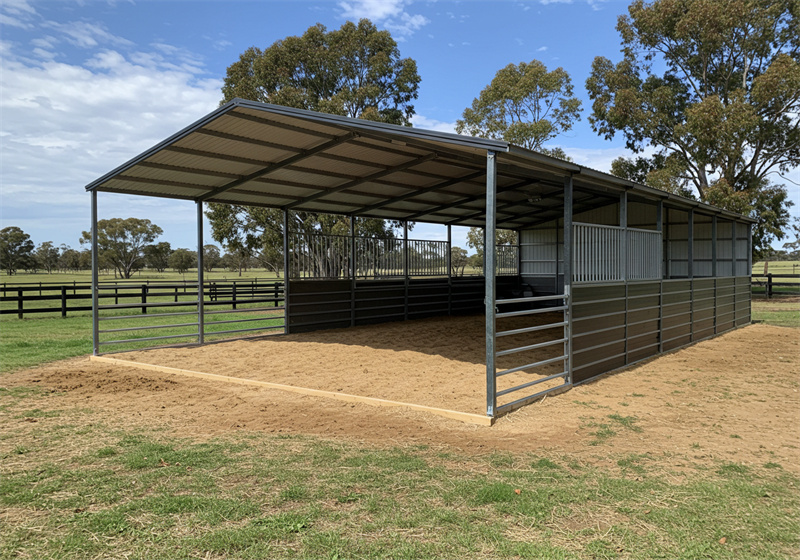
Plant vs Capital Works: ATO Traps
Bolting to concrete costs you 10x in depreciation speed.
ATO Ruling TD 97/24 draws a hard line: if a structure is affixed to a concrete slab in a way that requires demolition tools to remove, it is ‘Capital Works’ — depreciable at only 2.5% per year straight-line. That means a $50,000 stable generates just $1,250 in annual deductions. A portable, demountable flat-pack design, by contrast, qualifies as ‘Plant and Equipment’ under the same ruling, unlocking a 25% diminishing value rate. The difference in Year 1 alone is $12,500 versus $1,250. For a commercial investor, that is not a nuance — it is the single largest factor in ROI.
The trap is deceptively simple. A distributor sells a ‘portable’ stable, but the end-user bolts the frame into a concrete slab and pours a perimeter curb. Once the stable is mechanically fastened to a permanent foundation, the ATO reclassifies it as a building. The buyer loses the accelerated write-off, and the distributor gets blamed for selling a product that failed to deliver the promised tax outcome. The only way to guarantee Plant status is to supply a flat-pack, demountable system that sits on the ground or on removable footings — no permanent attachment.
- Classification Trigger: Any permanent fixing to concrete (bolts, anchors, poured curbs) triggers Capital Works at 2.5% p.a. straight-line.
- Plant Status Requirement: The structure must be demonstrably removable without structural damage. Flat-pack designs with bolted joints and no concrete embedment satisfy this test.
- Financial Impact: A $50,000 stable depreciated as Plant yields ~$12,500 in Year 1 (25% DV). The same stable classified as Capital Works yields $1,250. That $11,250 gap is real cash flow.
- Insider Warning: Some suppliers weld frames to steel base plates that are then bolted into concrete. That assembly is legally a ‘building’ under TD 97/24. Always verify that your supplier’s design uses removable footings or surface-mount brackets.
For B2B distributors importing flat-pack stables into Australia or New Zealand, the smart play is to sell the tax classification as a product feature. End-users who understand this distinction will pay a premium for a demountable design because it directly improves their cash flow. Suppliers who cannot document that their stables meet the Plant criteria — through design drawings, installation manuals, and material specs — are leaving money on the table for their clients and exposing themselves to liability. DB Stable’s flat-pack system, built with a hot-dip galvanized steel frame (42+ micron coating) and bolted joints, is engineered specifically to preserve Plant classification. No welding, no concrete embedment, no ambiguity.
Instant Asset Write-Off: Year 1 Cash Flow
Immediate write-offs keep capital working for you, not the tax office.
The Instant Asset Write-Off lets you deduct the full cost of eligible portable stables in the year of purchase — up to the ATO threshold (currently around $20,000–$30,000 per asset). For a commercial buyer putting in a single or double flat-pack stable, that means recovering 25–30 cents per dollar in the first tax year instead of stretching it over decades.
The real lever most buyers miss is the adjusted basis. Because DB Stable ships flat-pack, your landed cost — FOB price plus sea freight and insurance — is significantly lower than a pre-assembled competitor’s. A lower adjusted basis means your write-off captures a higher percentage of actual cash outlay. You are not paying for inflated shipping volume or bulky framing; you are deducting the efficient, modular cost.
- Cash flow impact: On a $25,000 stable kit, the write-off returns roughly $6,250–$7,500 in reduced tax liability in Year 1. That cash stays in your working capital for feed, vet bills, or the next container order.
- Flat-pack advantage: Flat-pack shipping cuts freight volume by up to 40% compared to welded or pre-assembled units. Lower freight = lower adjusted basis = more deduction per dollar you actually spend.
- High-spec components: Specifying hot-dip galvanized steel (42+ micron coating) and 10mm UV-stabilized HDPE panels increases the asset’s effective life to 10–20 years. That longevity protects your write-off from impairment adjustments — a risk that cheap timber or painted steel stables carry.
Bottom line: the Instant Asset Write-Off is not a discount — it is a timing advantage. Pair it with a flat-pack design and durable materials, and you maximize the net benefit per dollar spent. Competitors selling bolted-down, high-freight units force their buyers into a slower depreciation schedule and a higher adjusted basis. That is a structural disadvantage you can avoid.

Effective Life: Material Durability & Depreciation
Material specs don’t just protect horses — they protect your depreciation schedule.
The ATO assigns an ‘effective life’ to every depreciable asset. For portable stables classified as Plant and Equipment under ruling TD 97/24, that effective life typically runs 10 to 20 years for galvanized steel structures. Timber stables? The ATO expects 5 to 10 years max — and that’s before rot or termite damage forces an impairment write-down. The difference isn’t just durability; it’s tax treatment.
- Steel Spec: Hot-dip galvanized steel with a minimum 42-micron zinc coating. That coating is the barrier between your asset and the ATO’s impairment clause. Below 42 microns, pitting starts within 18 months in coastal AU/NZ environments, triggering a revised effective life and a potential claw-back of prior deductions.
- Panel Spec: 10mm UV-resistant HDP panels. Standard HDP warps under 6 months of Australian sun. Warped panels don’t just look bad — they signal to the ATO that the asset is degrading faster than declared, inviting an impairment review. UV-stabilized HDP holds dimensional stability for 10+ years.
- Risk: Timber stables or painted steel units with sub-42-micron coating. These materials force an impairment loss event within 3-5 years. The ATO then requires you to recalculate the remaining effective life downward, reducing your annual claim and potentially triggering a tax bill for prior over-claims. That’s a direct margin hit.
The math is straightforward: A $30,000 stable with a 15-year effective life yields $2,000 per year in depreciation (diminishing value). A $30,000 timber stable with a 5-year effective life yields $6,000 per year — but only if it lasts 5 years. If it rots in 3 years and the ATO reclassifies it to a 3-year life, you’ve over-claimed $12,000. That’s an impairment loss — a tax liability, not a deduction.
| Feature | Specification | Tax & Depreciation Impact |
|---|---|---|
| Material | Hot-Dip Galvanized Steel Frame (42+ micron coating) | ATO Effective Life: 10-20 years. Resists corrosion; protects asset value and prevents impairment losses. |
| Panel Material | 10mm UV-Resistant HDPE Panels | No warping or rot. Maintains structural integrity for full depreciation schedule; avoids ‘Warping Tax Risk’. |
| Construction Type | Flat-Pack / Demountable (Non-Permanent) | Qualifies as ‘Plant & Equipment’ (25% p.a. DV). Avoids 2.5% ‘Capital Works’ rate for permanent buildings. |
| Landed Cost Strategy | Lower FOB Price & Reduced Freight Costs | Lowers the ‘adjusted basis’ of the asset, increasing the effective tax deduction per dollar spent. |
| Invoicing Structure | Component-Level Invoicing (Frame vs. Roof) | Maximizes Year 1 deductions by classifying high-depreciation items (steel frame) as ‘Plant’ separately from roofing. |

Component-Level Depreciation: Maximizing Claims
Splitting invoices by component can unlock up to 10x faster depreciation on the steel frame alone.
Most buyers treat a portable stable as a single capital expense. That is a costly mistake. Under ATO Ruling TD 97/24, a demountable steel frame qualifies as ‘Plant and Equipment’ (25% diminishing value), while roofing and certain fixtures may fall under ‘Capital Works’ (2.5% straight line). By requesting a component-level invoice from your supplier — separating the hot-dip galvanized steel frame, the 10mm UV-resistant HDPE panels, and the roofing — you give your accountant the documentation needed to classify each element correctly.
Here is the financial impact: a $30,000 stable treated as a single building asset yields only $750 in Year 1 deductions (2.5% rate). Split the invoice so the $18,000 steel frame is classified as Plant — that single component alone generates $4,500 in Year 1 deductions (25% diminishing value). The HDPE panels, with an effective life of 10–15 years, can be depreciated separately as fixtures. The roofing, if bolted to a concrete slab, may stay at the Capital Works rate. The net result: Year 1 deductions jump from $750 to over $5,000, without changing a single bolt.
- Steel frame (Plant): Hot-dip galvanized, 42+ micron coating. 25% diminishing value. Effective life 10–20 years.
- HDPE panels (Fixtures): 10mm UV-resistant. Depreciated separately over 10–15 years. Avoids impairment loss from warping.
- Roofing (Capital Works): 2.5% straight line if permanently fixed. Keep it demountable to argue for Plant classification.
The warning here is direct: if your supplier ships a single-line invoice calling the whole unit a ‘building’ or ‘shelter’, your client’s accountant has no choice but to apply the 2.5% rate. DB Stable provides itemized packing lists and commercial invoices that break out frame, panels, and roofing by line item — this is not a service they advertise, but any distributor can request it. Competitors who weld frames to concrete footings or use painted steel that rusts within 3 years force a ‘building’ classification by default, destroying the buyer’s cash flow advantage. Component-level invoicing is a zero-cost strategy that turns a standard flat-pack kit into a tax-optimized asset.
Conclusion
The tax advantage of a portable stable isn’t a loophole. It’s a structural outcome of design. A flat-pack, demountable system built with 42-micron galvanized steel and 10mm HDPE panels qualifies for 25% plant depreciation and the Instant Asset Write-Off. Timber or bolted-down units lock your capital into a 2.5% building rate for decades. That difference changes the math on a 200-room project.
Review the flat-pack stable specs on the product page. Compare the material specs and tax classification data against your current supplier’s offering. The numbers will tell you which route protects your margin.
Frequently Asked Questions
Are horses a depreciable asset?
Yes, horses used in a business (e.g., breeding, racing, or agistment) are depreciable assets under Australian tax law. The effective life is determined by the horse’s type and use, typically ranging. Check the ATO’s effective life schedule for your specific horse use.
What is the most overlooked tax break in Australia?
The Instant Asset Write-Off is often overlooked by equine businesses for portable infrastructure like stables. Many buyers miss that a flat-pack, demountable stable qualifies as plant and equipment for an immediate deduction, unlike. Confirm the current ATO threshold before your purchase year-end.
What is depreciation for tax purposes in Australia?
Depreciation is the decline in value of a business asset over its effective life, deductible against your income. The ATO allows either the diminishing value method (faster early deductions) or the prime cost. Choose a method that matches your cash flow needs.
What is the depreciation rate for a horse?
The depreciation rate for a horse depends on its effective life, which the ATO sets at 5 to 15 years for breeding or racing stock. This translates to a diminishing. Use the ATO’s effective life tool to confirm your horse’s specific rate.
What is the 20% rule with horses?
The 20% rule refers to the ATO’s guideline that a horse’s effective life for depreciation is at least 5 years, which yields a 20% prime cost rate. This applies to horses. Verify your horse’s use and expected holding period with your accountant.