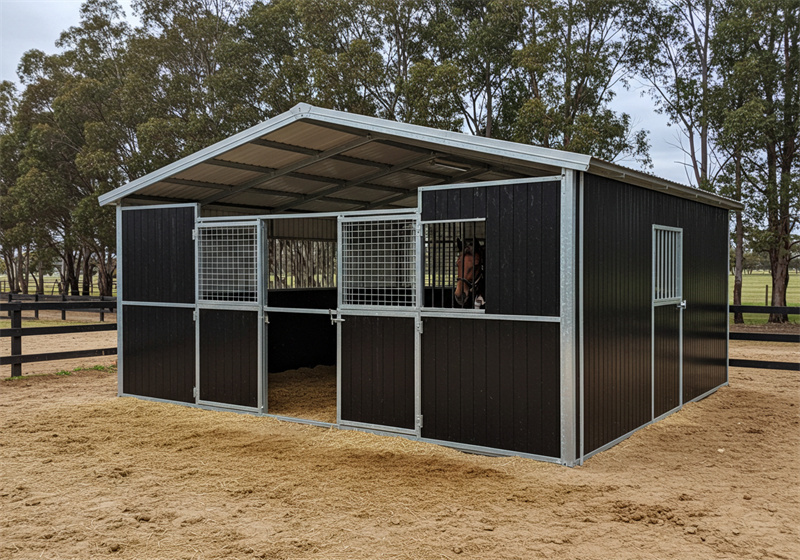
A custom stable design Australia project for a commercial equestrian centre isn’t about picking a pretty barn photo from a catalogue. It is about writing a procurement specification that will survive a 10-year loan term, a Queensland summer, and a council compliance inspection. You are past the ‘what size’ question. You already know you need a 3.6m x 3.6m stall. The real question is which factory can deliver that stall with materials that won’t rust from the inside out or warp in the January heat.
The gap between a brochure promise and a delivered stable kit is where most buyers get burned. Equestrian centres in Victoria have installed painted steel stables that looked solid at handover, only to have rust bleed from the bolt holes within 18 months. The reason is simple: the zinc coating stopped at the sheared edge. The panels were hot-dip galvanized before cutting, leaving every drilled hole and cut edge exposed. A proper custom stable design Australia spec demands hot-dip galvanizing after fabrication—covering every cut, hole, and weld. The lab report, not just the marketing photo, is what needs to be seen.

Stall Dimensions & Animal Welfare Compliance
Most Australian equestrian centres install stables that are structurally sound but fail on one critical spec: the zinc coating stops at the sheared edge. Here is how to spot that failure before you sign.
The debate between hot-dip galvanized and painted steel is not about preference—it is about survival in the Australian climate. Painted mild steel looks clean at installation. Eighteen months later, UV radiation and coastal salt cause micro-cracks in the paint. Moisture seeps in, the steel oxidises, and you are repainting or replacing panels. The real failure point is not the surface paint; it is the cut edges and drilled holes. Many imported stables are fabricated from pre-galvanized sheet. The zinc coating exists only on the flat faces. Every sheared edge, every bolt hole exposes raw steel. That is where rust starts, and it spreads inward.
Hot-dip galvanizing per AS/NZS 4680 solves this. The entire fabricated assembly—including all cut edges, drilled holes, and weld points—is immersed in molten zinc. The minimum coating thickness is 42 microns, equivalent to 600 g/m² of zinc. That coating provides cathodic protection: even if the surface is scratched, the surrounding zinc corrodes first, protecting the underlying steel. You must spec 42 microns or you will repaint in 2 years. Painted steel offers zero cathodic protection. Once the paint chips, the corrosion rate accelerates.
The second material decision is the stall lining. Plywood is common in budget builds, but it warps 10 mm per metre in 40°C heat. That means a 3.6 m stall wall can bow 36 mm—enough to jam doors and create gaps where horses can trap limbs. 10 mm UV-resistant HDPE panels have near-zero thermal expansion. They do not absorb moisture, they resist kicking damage, and they clean down with a pressure washer. The trade-off is upfront cost: HDPE is roughly 30% more expensive than marine-grade plywood. The payback is zero maintenance over 10 years versus replacing plywood every 3–4 years.
Here is the checklist for your supplier quote:
- Galvanizing certificate: Request the mill test report showing coating weight per AS/NZS 4680. If the supplier cannot provide it, assume the coating is substandard.
- Post-fabrication dipping: Ask whether the steel is hot-dipped before or after cutting and drilling. The answer must be after fabrication to protect cut edges.
- HDPE thickness: Confirm 10 mm minimum. 8 mm panels flex under horse pressure and crack at fixing points.
- Thermal expansion data: Request the coefficient of linear expansion for the panel material. For HDPE, it should be approximately 1.5 x 10⁻⁴ /°C—near-zero movement in Australian conditions.
Verify these four specs on your supplier quote. If any are missing, the stable will cost you more in maintenance than you saved on the purchase price.
| Feature | Specification | Advantage |
|---|---|---|
| Frame Material | Hot-Dip Galvanized Steel (AS/NZS 4680) | 42+ micron zinc coating; 10+ year outdoor life; no rust from bolt holes |
| Panel Material | 10mm UV-Resistant HDPE | Near-zero thermal expansion; won’t warp in 40°C heat; no door-jamming |
| Stall Dimensions | 3.6m x 3.6m (11.8ft x 11.8ft) | Meets NSW DPI welfare guidelines; suitable for thoroughbreds |
| Door Width | 1.2m (4ft) swing-out door | Safe for horse passage; sliding doors are unsafe and not recommended |
| Roof Overhang | 900mm with gutter/downpipe system | Prevents water runoff into stall; protects panels from UV and rain |
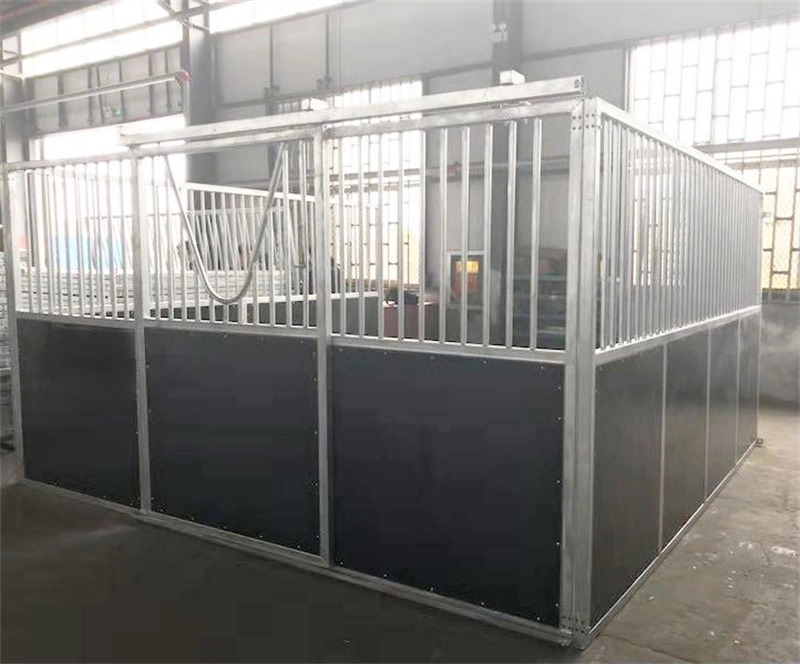
| Feeder Type | Swivel feeder in rust-free aluminum | Prevents leg trapping; easy to clean; no corrosion |
| Modularity | Tie-plate / splint connection system | Reconfigurable layout (4m to 5m) in one day; no welders needed; saves $4k–$6k per change |
| Foundation Requirement | Level compacted road base (±3mm per 2m) | Ensures bolt-up alignment; avoids ‘door won’t shut’ complaints |
| Compliance Standard | AS/NZS 4680 for galvanizing | Certifiable for council permits; meets Australian import regulations |
| Pricing (FOB 4-stall) | $9,200–$12,800 AUD | 40–60% less than local welded steel builds; factory-direct savings |
Material Selection: Hot-Dip Galvanized vs Painted Steel
Painted steel looks solid at install. At year two, it flakes from bolt holes. Hot-dip galvanizing after fabrication is the only way to seal cut edges.
You will see two options in the Australian market: painted mild steel and hot-dip galvanized (HDG) steel. The difference is not appearance—it is the corrosion protection at every sheared edge and drilled hole.
Painted steel frames are fabricated from pre-coated coil. The factory cuts the steel, punches bolt holes, and welds joints—exposing raw metal at every cut edge and weld bead. Once moisture hits that exposed edge, rust begins under the paint film. Within 18 to 24 months in Australian UV and coastal humidity, you get paint blistering and flaking. The structural integrity remains, but the aesthetic failure and rust runoff stain your concrete pad.
Hot-dip galvanizing after fabrication solves this. The entire assembled frame is dipped in molten zinc at 450°C. The zinc bonds metallurgically to the steel, coating every interior surface, every bolt hole, every weld. The standard is AS/NZS 4680, which requires a minimum 42-micron zinc coating—equivalent to 600 g/m². This gives you a 10+ year outdoor life in Australian conditions before any maintenance is needed.
Here is the procurement checklist for material selection:
- Verify the coating standard: Demand a certificate stating compliance with AS/NZS 4680. Do not accept “galvanized” without a micron thickness value. 42 microns minimum.
- Ask when the galvanizing happens: If the supplier says “pre-galvanized steel coil,” the cut edges are unprotected. You want “hot-dip galvanized after fabrication.”
- Check for edge coverage: Request a photo of a drilled hole cross-section. The zinc coating should be visible inside the hole, not just on the flat surface.
- Wall panel material: Pair HDG steel frames with 10mm UV-resistant HDPE panels. HDPE has near-zero thermal expansion—unlike plywood, which warps 10mm per meter in 40°C heat. Warped panels cause door jamming within one summer.
Many Australian equestrian centres install imported painted steel stables that look solid at install but rust from the bolt holes within two years. The zinc coating stops at the sheared edge because the steel was pre-coated before cutting. Real HDG applied after fabrication covers every drilled hole and cut edge. Verify this spec on your supplier quote—do not assume it is standard.
| Feature | Specification | Advantage |
|---|---|---|
| Frame Material | Hot-Dip Galvanized Steel (AS/NZS 4680) | 42+ micron zinc coating; 10+ year outdoor life in Australia |
| Panel Material | 10mm UV-Resistant HDPE | Near-zero thermal expansion; no door jamming in 40°C heat |
| Stall Dimensions | 3.6m x 3.6m (11.8ft x 11.8ft) | Meets NSW DPI welfare guidelines for horse comfort |
| Door Width | 1.2m (4ft) swing-out door | Safe for horse passage; sliding doors are a vet risk |
| Roof Overhang | 900mm | Protects panels from rain; includes gutter/downpipe system |
| Feeder Type | Swivel feeder in rust-free aluminum | Prevents leg trapping; no corrosion from feed acids |
| Modularity | Tie-plate splint system | Reconfigure stall size (4m to 5m) in one day; no welders needed |
| Galvanizing Coverage | Post-fabrication hot-dip | Covers every cut edge and bolt hole; prevents rust from sheared edges |
| Site Prep Tolerance | ±3mm per 2m level surface | Ensures bolt-up alignment; avoids ‘door won’t shut’ complaints |
| Cost per Stall (FOB) | $9,200–$12,800 AUD (4-stall barn) | 40–60% less than local Australian welded steel builds |
Layout Planning: Barn Configurations & Flow
A 1cm dip in your road base translates to a door that won’t latch. Flat-pack kits demand surgical precision—±3mm per 2m—that most compacted pads don’t deliver.
You’ve read the competitor guides. They all say the same thing: “Use compacted road base.” That advice works for a fully welded steel barn that can flex over uneven ground. It fails for a flat-pack kit where every panel bolts to the next. If your pad is out by more than 3mm over a 2m span, the bolt holes won’t align. The frame twists. The door jams. You spend a weekend shimming panels instead of moving horses in.
Here is the spec that matters: your base must be level to ±3mm per 2m in any direction. That requires a laser level during grading, not a spirit level. The sequence is: strip 150mm of topsoil, lay geotextile fabric, compact 100mm of 20mm road base in two lifts, then cap with 50mm of crusher dust. Compact each lift to 98% Standard Proctor density. Test it with a 2m straightedge before the kit arrives.
The slope is separate from level. You need a 1:30 gradient (3.3%) across the pad to shed water. In heavy Australian rain, a flat pad pools water under the HDPE panels, which attracts termites and rusts the base rail from underneath. The slope must run perpendicular to the stall doors so water drains away from the entrance, not into the aisle.
Verify this spec on your supplier quote: Ask for the maximum allowable deviation in mm per 2m for the foundation. If they can’t give you a number, they haven’t designed for flat-pack tolerances.
Site Prep Foundation Report
Your stable is only as good as the ground it sits on. A 1cm discrepancy in your base will turn a $12,000 flat-pack kit into a door-jamming nightmare.
This is the section where most importers get burned. Competitors like Guerilla Steel will tell you “compacted road base works.” They’re technically correct, but they omit the critical tolerance requirement for imported flat-pack kits. Unlike fully welded Australian stables that can flex over uneven ground, your modular bolt-up system demands a surface flat to within ±3mm per 2m. Miss that spec, and your bolt holes won’t align. Your doors won’t swing. You’ll be calling a welder on day one.
Here is the procurement-grade site prep checklist for a factory-direct custom stable:
- Strip topsoil: Remove 150mm of organic material. Organic matter compresses over time, causing your level surface to sink unevenly.
- Compact 100mm road base: Use 20mm minus crushed rock. Compact to 95% standard proctor density. This is your load-bearing layer.
- Set a 1:30 slope (3.3%): This is the minimum gradient for drainage during heavy Australian rain. Water pooling under your stable accelerates corrosion at the base plate contact points.
- Install anchor points: Set 4×4 treated pine posts or concrete footings at each corner post location. Your kit will bolt to these, not to the ground.
- Verify level with a 2m straightedge: Place it across the pad in multiple directions. Any gap over 3mm means you need another pass with the compactor. This is the step cheap importers skip.
You do not need a full concrete slab for a flat-pack stable kit. A well-compacted road base with anchor points is sufficient and saves you $3,000–$5,000 AUD per stall versus a concrete pour. However, if your council permit requires a slab for flood compliance or fire rating, you must pour it. Check with your local building surveyor before ordering.
Takeaway: Demand a site prep diagram from your supplier showing their required flatness tolerance. If they can’t give you a number, they haven’t engineered for bolt-up assembly. Verify this spec on your supplier quote.

Fittings & Horse Safety Hardware
A 3.6m x 3.6m stall is the legal minimum for horses in Australia. Anything smaller violates welfare codes and stresses the animal.
You already know a horse needs room to turn around and lie down. But “room” is not a feeling—it’s a measurement. The NSW DPI welfare guidelines set the baseline at 3.6m x 3.6m (11.8ft x 11.8ft) for a standard horse. For foaling or maternity stalls, you must bump that to 4m x 4m. These aren’t suggestions; they are the floor for council permit approval in most states.
Door width is another non-negotiable. Spec a 1.2m (4ft) wide swing-out door. Sliding doors look clean but create a pinch point—horses panic, get trapped, and injure themselves. A swing-out door clears the full opening without obstruction. The ceiling height needs to be at least 2.4m to allow for adequate ventilation above the horse’s head and to prevent heat buildup.
If you are designing a layout for 8 horses, the critical dimension is the aisle. A center-aisle barn with stalls on both sides requires a minimum 3m-wide aisle. This is not for storage—it is for turning a horse safely without scraping its hip against a post. A shed-row layout (stalls on one side only) can work with a 2.4m overhang, but you lose weather protection for the handler.
Takeaway: Verify your supplier’s stall dimensions against the NSW DPI guidelines. If they quote 3.5m x 3.5m to save on steel, reject the quote. That 10cm gap per side is enough to cause tail rubbing and stress in a confined horse.
Cost Breakdown & Factory Direct Savings
Factory-direct FOB pricing for a 4-stall custom barn from DB Stable is $9,200–$12,800 AUD. The same build from an Australian steel fabricator runs $18,000–$25,000 per stall. The gap is real, but only if you avoid the hidden costs that burn importers.
Let’s start with the headline numbers. A custom 4-stall barn from a Chinese factory like DB Stable costs between $9,200 and $12,800 AUD on a FOB (Free On Board) basis. That’s roughly $2,300 to $3,200 per stall. A local Australian builder using welded steel and plywood will quote you $18,000 to $25,000 per stall. The 6x to 8x multiplier isn’t a markup—it’s the cost of Australian labor, steel premiums, and local compliance overhead.
But the FOB price is only half the story. You need to account for three variable costs that determine the final landed figure:
- Shipping: A 20ft container from China to Sydney or Melbourne runs approximately $3,500 AUD. A 4-stall flat-pack kit fits in one container. A 6-stall barn typically requires a 40ft container at $4,500–$5,500 AUD.
- Duty & GST: Customs duty on steel structures is 5%. GST is 10%. On a $12,000 FOB order, that’s $600 duty and $1,260 GST—total $1,860 AUD in government fees.
- Site prep: Leveling, compacting 100mm of road base, and setting anchor points runs $2,000–$5,000 AUD depending on your yard’s condition. This is where cheap importers lose money—they skip the ±3mm level spec and end up with misaligned doors.
Add it up: a 4-stall barn at $12,000 FOB, plus $3,500 shipping, plus $1,860 duty/GST, plus $3,000 site prep, lands at roughly $20,360 AUD delivered and installed. Compare that to $80,000–$100,000 for a local welded build. The math favors factory-direct by a factor of 4x, even after all costs.
Here’s the catch most buyers miss. The savings evaporate if you choose painted mild steel instead of hot-dip galvanized. A painted steel stable costs $1,500–$2,000 less per stall upfront, but you’ll repaint in 18 months ($800–$1,200 per stall per coat) and replace rusted panels in 5 years ($3,000–$4,000 per stall). Over a 10-year horizon, the painted option costs more than the HDG build. The 42-micron zinc coating isn’t a premium—it’s an insurance policy against replacement.
For a 6-stall barn, the math scales linearly. Expect FOB pricing of $13,800–$19,200 AUD, plus shipping ($4,500–$5,500 for a 40ft container), duty/GST ($2,070–$2,880), and site prep ($3,000–$5,000). Total landed cost: $23,370–$32,580 AUD. That’s $3,895–$5,430 per stall. A local builder will quote $18,000–$25,000 per stall for the same footprint. The delta funds your next round pen or wash bay.
Takeaway: Get a FOB quote from your supplier that itemizes the steel grade (HDG per AS/NZS 4680), panel thickness (10mm HDPE), and stall dimensions (3.6m x 3.6m). Then add 30–40% for shipping, duty, and site prep. If the supplier can’t provide a galvanizing lab report or a compliance certificate for the stall dimensions, walk. The 4x savings only hold if the specs are real.
| Feature | Specification | Compliance | Benefit |
|---|---|---|---|
| Stall Dimensions | 3.6m x 3.6m (11.8ft x 11.8ft) | NSW DPI welfare guidelines | Meets minimum legal size for horse comfort & safety |
| Door Width | 1.2m (4ft) swing-out | Australian safety standards | Allows safe horse passage; prevents injury from sliding doors |
| Frame Material | Hot-dip galvanized steel (HDG) | AS/NZS 4680 standard | 42+ micron zinc coating; 10+ year outdoor life in Australia |
| Panel Material | 10mm UV-resistant HDPE | Thermal stability tested | Near-zero expansion in 40°C heat; no door jamming |
| Roof Overhang | 900mm (3ft) | Australian rain runoff design | Protects walls & doors from water damage; extends lifespan |
| Drainage System | Gutter & downpipe system | 1:30 slope (3.3%) pad drainage | Prevents water pooling; reduces rot & rust risk |
| Feeders | Swivel feeders in rust-free aluminum | Horse safety design | Prevents leg trapping; easy to clean & maintain |
| Modularity | Tie-plate splint system | Reconfigurable layout | Change stall size (4m to 5m) in one day; no welders needed |
| Galvanizing Coverage | Post-fabrication hot-dip | Covers all cut edges & drilled holes | No rust from bolt holes within 2 years |
| Site Prep Tolerance | ±3mm per 2m level surface | Flat-pack bolt-up requirement | Prevents panel joint misalignment & door issues |
Conclusion
A custom stable design for your Australian equestrian centre is a procurement decision that directly impacts horse safety, operational costs, and regulatory compliance for the next decade. The checklist above distills the non-negotiables: 3.6m x 3.6m stalls with 1.2m doors, hot-dip galvanized steel at 42 microns, and 10mm HDPE panels that eliminate thermal warping. Spec these correctly, and you avoid the hidden costs of rust, vet bills, and layout changes that plague cheaper builds.
Review your current stable setup against these specs. If you are planning a new build or upgrade, compare factory-direct options that certify HDG steel and HDPE compliance—like the modular kits at DB Stable—to see how they align with your yard’s layout and budget.
Frequently Asked Questions
What are the minimum stall dimensions for an equestrian centre in Australia?
The minimum stall size for a horse in Australia is 3.6m x 3.6m, with 1.2m-wide doors and a 2.4m ceiling height. For foaling or maternity stalls, you should spec 4m x 4m. Always verify dimensions against your local state’s animal welfare code.
Do I need a concrete slab for a flat-pack stable kit?
No, a concrete slab is not required for a flat-pack stable kit, but you do need a perfectly level, compacted road base or gravel pad. Even a 1cm dip in the base will cause. Invest in site prep before the kit arrives.
Is hot-dip galvanized steel better than painted steel for custom stables?
Yes, hot-dip galvanized steel is significantly better because the 42+ micron zinc coating meets the AS/NZS 4680 standard and lasts over 10 years, while painted mild steel often flakes and rusts within 18. Spec HDG steel for any outdoor or coastal installation.
Can I import a custom stable for my equestrian centre from China?
Yes, you can import a custom stable from China, and factory-direct suppliers like DB Stable offer flat-pack designs that simplify shipping and reduce costs by 40–60% per stall compared to local welded. Confirm the supplier meets AS/NZS 4680 coating standards before ordering.
How much does a custom 6-stall barn cost delivered to Australia?
A custom 6-stall barn from a factory-direct Chinese manufacturer typically costs 40–60% less per stall than a fully welded Australian steel build, but the exact delivered price depends. Request a detailed quote with incoterms and port of discharge to lock in costs.