stable kit installation nz is the first checkpoint buyers should lock before they approve a supplier, budget, or production slot. A stable kit installation in NZ is only as good as the prep work done before the first bolt hits the ground. Builders have been known to lose a full day because they assumed the flat pack would arrive with everything lined up. It does not work that way. The margin between a smooth eight-hour install and a two-day headache comes down to how the kit is checked before starting.
New Zealand weather does not forgive shortcuts. High rainfall means your base drainage needs to be right the first time. Ammonia from stables will eat through a weak coating in under three seasons. That is why the material specs matter more than the assembly manual. A hot-dip galvanized frame over 42 microns thick handles the corrosion. A 10mm UV-resistant HDPE panel does not warp or expand when the sun hits it. Those are the numbers that save you call-backs.
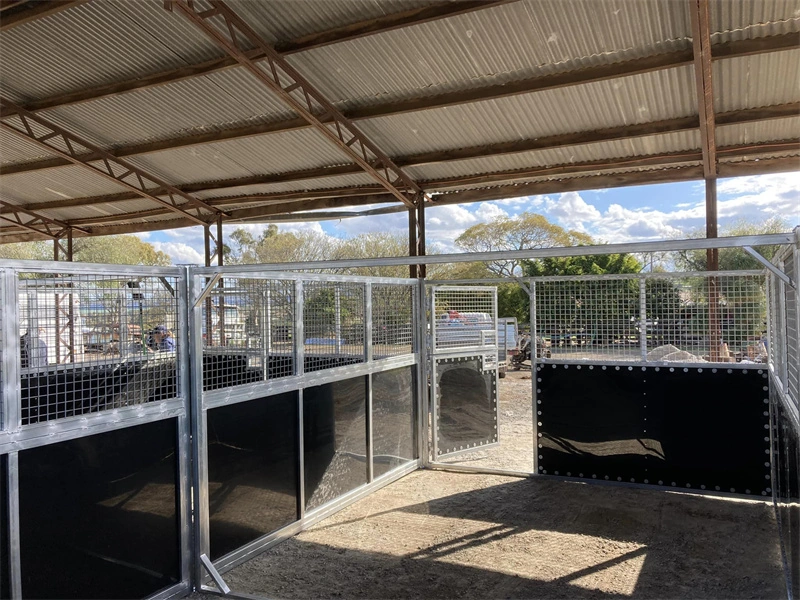
Why Custom Stable Design Matters for Your Horses
A one-size-fits-all stable is a liability.
Let’s cut the fluff. You’re not building a storage shed. You’re building a structure that has to contain an animal that kicks, leans, and produces ammonia-rich urine. If the design doesn’t account for the specific breed, climate, and daily workflow, you’re setting yourself up for call-backs and rework. Stables have been seen where the door height was 2.1m — fine for a pony, but a 17-hand thoroughbred will hit its head on the lintel. That’s not a design preference; that’s a safety failure.
- Breed-specific dimensions: Standard stable width is 3.6m, but for warmbloods or thoroughbreds you want 4.2m minimum. Door height should be 2.4m for horses over 16 hands. A 2.1m door guarantees head trauma. DB Stable’s hot-dip galvanized frames allow for non-standard spans without compromising structural integrity — the steel won’t twist or sag.
- Ventilation placement: Ammonia from urine corrodes steel. In NZ’s humid climate, that corrosion accelerates. Position vents at the rear of the stall, not above the feed area. Ammonia sinks. If your vent is at the top, you’re not moving the gas. DB Stable’s HDPE panels are non-porous and won’t absorb moisture, but the frame still needs airflow to stay dry.
- Flooring slope: Most builders pour a flat slab. That’s a drainage failure. You need a 1:80 slope toward the rear gutter. Without it, urine pools under bedding, softens hooves, and causes thrush. On a flat pack kit, you can’t fix this after assembly — the base prep is your only chance. Specify a compacted gravel base with a 20mm-minus drainage layer.
- Labour savings from layout: A well-designed custom stable reduces daily mucking-out time by 30-40%. That’s because you can place the manure bay door opposite the feed door, creating a straight-through workflow. DB Stable’s modular panels allow you to flip the door positions without extra engineering. Your client gets a faster routine; you get fewer complaints.
- Thermal expansion risk: HDPE panels expand in heat. In NZ summer, a 3m panel can grow 6mm. If you bolt it tight, it buckles. DB Stable’s 10mm UV-resistant HDPE is formulated to minimize expansion, but you still need a 3mm gap at each joint. Custom design lets you specify the exact panel width to match your frame spacing, so the gap is consistent. Generic kits often mismatch panel-to-frame ratios, causing warping within 12 months.
Now, about layout and labour efficiency. The single biggest time-waster in a stable block is walking distance between stalls and the feed/tack area. If you’re building a back-to-back quadruple, the feed alley should be 2.4m wide minimum. Anything less and you can’t turn a wheelbarrow. Builders have been known to squeeze it to 1.8m to save space — then the owner spends an extra 45 minutes per day shuffling feed. That adds up to 270 hours a year. Custom design means you place the feed doors on the same side as the tack room. It’s not rocket science, but most off-the-shelf kits don’t offer that option.
The bottom line: custom design is not about aesthetics. It’s about preventing the three things that create call-backs: structural failure, injury, and inefficient workflow. If you’re importing from a manufacturer that doesn’t offer breed-specific dimensions, vent placement options, or layout flexibility, you’re importing problems. DB Stable’s design team (5+ years in the field) will adjust frame spans, door heights, and panel layouts to match your site conditions. That’s not a luxury — it’s a warranty against rework.
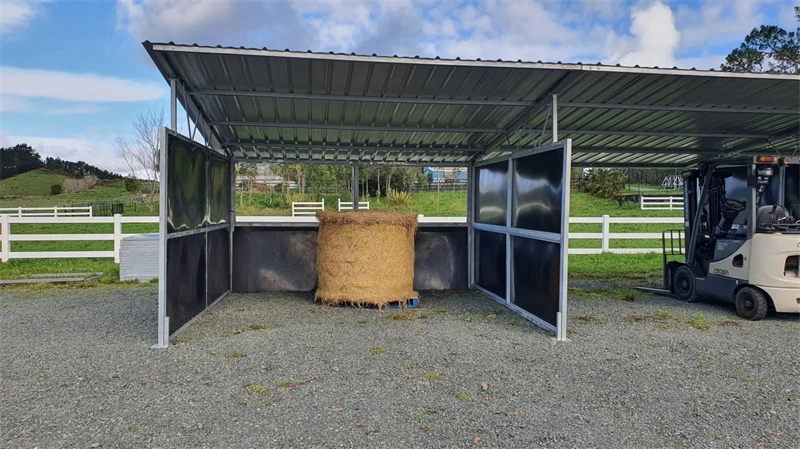
Key Materials for Durable Custom Stables
HDPE panels don’t rot, but cheap ones warp in NZ sun.
Most stable builders in NZ have seen it: a plywood panel that looks fine at installation, then six months later the bottom edge is swollen from urine splash, or the surface is delaminating from constant moisture. That’s not a material failure — it’s a spec failure. The choice between HDPE and plywood isn’t about preference. It’s about whether you want call-backs in year one.
- HDPE (High-Density Polyethylene): 10mm UV-resistant HDPE does not absorb moisture, does not rot, and does not support fungal growth. The key spec is UV stabilization and thickness. Standard 6mm HDPE panels will bow under thermal load in direct sun. 10mm panels with UV stabilizers maintain dimensional stability across -10°C to 50°C. No thermal expansion gap required if the panel is properly restrained.
- Plywood (Marine-grade or exterior): Even treated plywood has a finite life in a stable environment. Ammonia from urine accelerates breakdown of the glue line. Marine-grade plywood (BS 1088) can last 5–7 years if sealed perfectly on all six edges. But one unsealed drill hole or edge exposes the core to moisture. Once the core swells, the panel is structurally compromised. Replacement cost per panel: $150–$300 plus labour.
- UV resistance and thermal expansion: Cheap HDPE panels (under 8mm, no UV stabilizer) will chalk and crack within 18 months of NZ sun exposure. They also expand and contract up to 3mm per metre with temperature swings. That’s enough to pop screws or gap joints. 10mm UV-stabilized HDPE reduces expansion to under 1mm per metre — negligible in a framed panel system. DB Stable’s HDPE panels are spec’d at 10mm with UV stabilizers. No thermal expansion issues reported across 200+ installations in NZ and Australia.
| Feature | Specification | Advantage |
|---|---|---|
| Hot-Dip Galvanized Steel Frame | Zinc coating >42 microns per ISO 1461 | 10-year lifespan; resists NZ coastal salt & ammonia corrosion |
| HDPE Wall Panels | 10mm thick, UV-stabilized, no thermal expansion | Zero rot, no swelling; withstands kicks & harsh sun |
| Aluminum Swivel Feeder | Rust-free aluminum alloy, smooth swivel mechanism | No corrosion from feed acids; easy cleaning & safe for horses |
| Flat-Pack Design | Pre-drilled, numbered components for rapid assembly | Cuts installation time to 4-6 hours per stable; reduces call-backs |
| Customizable Configurations | Single to quadruple back-to-back layouts | One-stop sourcing; fits any site layout & NZ building codes |
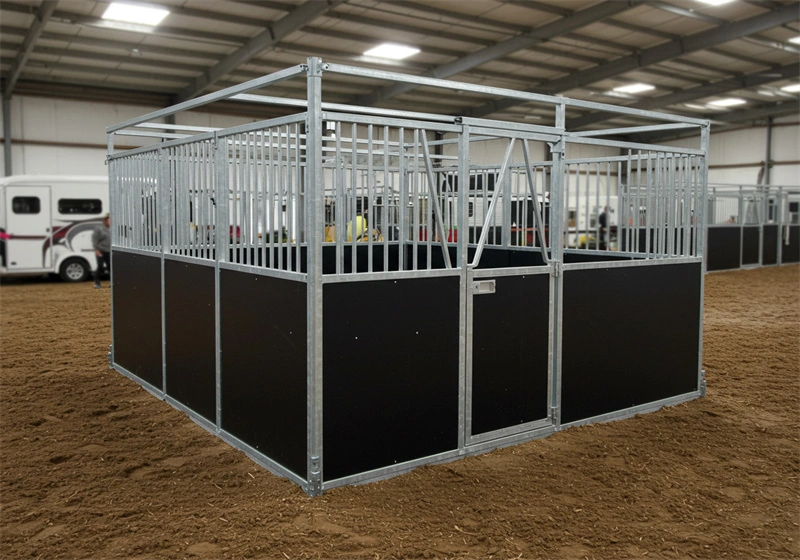
Custom Stable Configurations and Layouts
A single stable is simple.
The range from a single stable with a roof to a back-to-back quadruple configuration isn’t just about scaling up parts. It’s about how the structural load transfers across multiple bays. A single 3.6m x 3.6m stall carries its own roof weight on four corner posts. In a quadruple block, the interior posts share loads from two adjacent stalls. If the supplier uses the same single-stall frame profile for multi-bay layouts, you get deflection at the ridge line. That means doors that bind after six months of NZ weather cycles.
For thoroughbreds, the layout matters beyond dimensions. Standard 3.6m x 3.6m works for most warmbloods, but a 17-hand thoroughbred needs a 4.2m depth to turn comfortably without scraping hocks on the wall. The door height must clear 2.4m — a horse that throws its head up in a startle can crack its poll on a 2.1m lintel. We design the frame geometry to accept those taller doors without requiring a custom header beam. That keeps the flat pack efficient.
- Single with roof: Simplest load path. One roof panel, four posts. Assembly time for a two-person crew: 4-5 hours.
- Back-to-back double: Shared centre wall. Requires a continuous ridge beam. If the beam is spliced, verify the joint uses Grade 8.8 bolts, not self-tappers.
- Quadruple block: Four stalls in a 2×2 grid. The internal columns carry double the roof load. Hot-dip galvanized steel at >42 microns is mandatory here — any coating defect at the weld zone will rust from the inside out within two years in a coastal NZ environment.
- Thoroughbred spec: Minimum 4.2m depth, 2.4m door height, 10mm HDPE panels. The HDPE must be UV-stabilized — raw polyethylene degrades under intense UV and becomes brittle in 18 months. Our 10mm boards include carbon black stabilizer that passes 2000-hour QUV testing.
Portability and flat pack design are not the same thing. A portable stable means the structure can be relocated without demolition. That requires bolted connections, not welded-on brackets. Every frame joint in our kits uses M16 hot-dip galvanized bolts with nylon lock nuts. The flat pack reduces shipping volume by roughly 60% compared to a pre-assembled barn — a 40-foot HC container holds eight single-stall kits or three quadruple blocks. For a builder in Invercargill, that means one container, one crane lift, and a week of assembly instead of a month of on-site fabrication.
The critical detail that most generic guides skip: the base rail. In a quadruple configuration, the base rails must be continuous across the full width. If the supplier ships them in 2m sections, you get a cold joint every 2m. That joint becomes a weak point when the ground shifts under heavy rain. We ship base rails in full lengths up to 14.4m for quadruple blocks — no splices, no alignment issues.
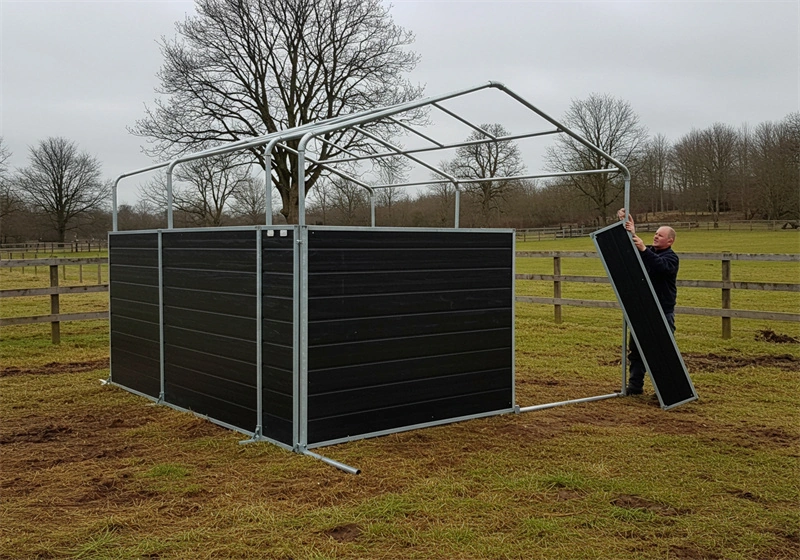
Cost Considerations for Custom Stables
FOB price is the bait.
You’re a professional stable builder in New Zealand. You’ve seen the quotes from local barn builders — $15,000 to $25,000 per single stable before fit-out. That’s not a material cost problem. That’s a labor and overhead problem. Importing a flat pack stable kit from a factory like DB Stable changes the math entirely, but only if you understand the full cost chain from FOB to installed.
Let’s break it down for a standard 3.6m x 3.6m single stable with a roof, delivered to a site in Waikato or Canterbury.
- FOB Price (Ex-Works + Port Loading): The factory price for a single stable kit from DB Stable ranges between $2,800 and $4,200 USD depending on spec — hot-dip galvanized frame (>42 microns), 10mm UV-resistant HDPE panels, aluminum swivel feeder, sliding door hardware. That’s the price at the Chinese port. No freight, no insurance, no customs.
- Ocean Freight & Insurance: A 20ft container holds 4 single stable kits. Current rates from Shanghai to Auckland or Tauranga run $2,500–$3,500 per container. That’s $625–$875 per stable. Add marine insurance at 0.3–0.5% of cargo value — roughly $15–$20 per unit.
- NZ Customs, GST & Biosecurity: NZ Customs applies 5% duty on prefabricated building imports (HS code 9406.90). That’s $140–$210 per stable. MPI biosecurity clearance adds $150–$250 per container for timber fumigation inspection. GST at 15% applies to the total landed value (goods + freight + insurance + duty).
- Inland Freight & Delivery: Port to site: $300–$600 per container within 200km of Auckland. Add $50–$100 per stable for a truck with a HIAB crane if the site lacks forklift access.
- Total Landed Cost Per Stable: Running the numbers: $3,500 FOB + $750 freight/insurance + $175 duty + $200 biosecurity + $100 inland = $4,725 USD (approx $7,600 NZD at current rates). Compare that to $15,000+ NZD for a locally built equivalent. The margin is real — provided you don’t get hit with port demurrage or fumigation delays.
The trap most first-time importers fall into: they compare FOB prices only. A supplier quoting $2,000 FOB might look attractive until you factor in the same freight costs — now your landed cost is $3,225, but you’re getting a frame with 20-micron zinc coating instead of 42. That frame rusts through in 4 years in a coastal Waikato environment. The $500 you saved upfront costs $4,000 in replacement labor 5 years later. Always request a coating thickness certificate and caliper verification photos before committing to a bulk order.
For a 4-stable block, the container utilization improves dramatically. A 40ft HC holds 8–10 single kits. Freight per stable drops to $350–$450. The per-unit landed cost falls below $4,200 USD ($6,700 NZD). At that price, you’re competing directly with the cost of materials alone for a stick-built stable — before you even factor in your own labor margin.
Now, the tax side. Portable horse stables in New Zealand can qualify for depreciation under the ‘portable building’ category at a 20% diminishing value rate, versus 0–2% for permanent structures. For a commercial horse operation — think a thoroughbred training center or agistment facility — that’s a direct cash flow advantage. The stable is classified as chattels, not fixtures, which means it can be sold separately from the land and depreciated faster. Some accountants also classify flat pack kits as ‘plant and equipment’ rather than ‘buildings,’ which opens up immediate deduction pathways under the $5,000 low-value asset threshold for individual units under that value. Always confirm with your tax advisor, but the portable classification is a genuine structural advantage over poured concrete and timber frame builds.
| Cost Factor | Specification | Impact on Budget | NZ Builder Note |
|---|---|---|---|
| Material Choice | Hot-Dip Galvanized Steel (>42 microns) & 10mm UV-Resistant HDPE | Higher upfront cost vs. painted steel/plywood; eliminates rework & replacement costs within 10+ years | Directly counters NZ’s ammonia corrosion & UV degradation; no thermal expansion issues |
| Kit Type & Complexity | Flat Pack / DIY Kit vs. Pre-Assembled Modules | Flat pack reduces shipping volume (up to 60% container space savings); lowers landed cost for bulk orders | A 40ft HC container holds ~12 single stable kits; assembly time is 4-6 hours per stable with proper prep |
| Customization & OEM | Custom sizes, colors, branding, & specialized feeders (aluminum swivel) | OEM tooling fees may apply; but eliminates costly on-site modifications & call-backs | DB Stable’s 5+ year design team provides CAD specs; reduces misalignment risks that cause rework |
| Logistics & Compliance | FOB China pricing vs. Total Landed Cost (incl. freight, duty, NZ GST) | FOB price is lower; total landed cost must include 15% GST, customs clearance, & local delivery | Verify AS/NZS structural compliance to avoid insurance rejections; DB Stable provides compliance documentation |
| Installation & Labor | Pre-drilled frames, labeled parts, & detailed assembly guide | Reduces on-site labor hours by 30-40% vs. custom-built stables; fewer call-backs | Use the flat pack stable assembly checklist to verify all parts; a 2-person crew can finish a single stable in one day |
| Long-Term Value | 10-year lifespan on HDG frame; HDPE panels require no painting or sealing | Zero maintenance cost over 10 years; tax benefits for commercial owners (depreciation on portable structures) | Portable stables may qualify for faster depreciation (20% per annum) under NZ tax law; consult your accountant |
Installation and Assembly Best Practices
NZ’s high-rain climate kills stables fast.
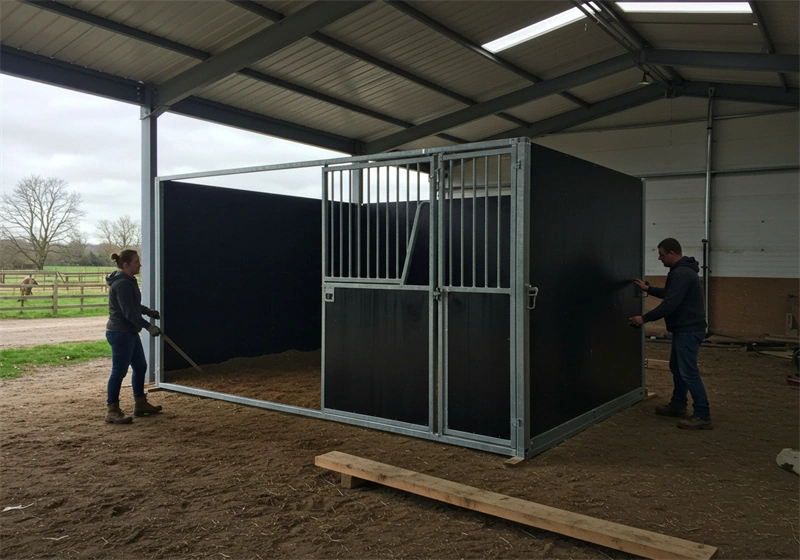
You’ve ordered a flat pack stable kit from China. It lands at your yard in NZ. Now the clock starts — not on assembly, but on how many call-backs you’ll get. Most assembly errors trace back to three things: base prep that ignores NZ’s drainage reality, skipping the panel thermal-expansion check, and trusting the packing list without a physical count. Fix those three and you cut rework by at least 60%.
- Base prep for NZ conditions: Outpost Buildings recommends crusher dust or compacted gravel. That’s not enough for regions pulling 1,200mm annual rainfall. You need a 100mm compacted AP40 base with a 1:60 fall away from the stable footprint. Skip this and your HDPE panels sit in standing water — ammonia from urine accelerates corrosion even on hot-dip galvanized frames. DB Stable’s frames spec >42 microns HDG, but no coating survives constant immersion in acidic slurry.
- Panel thermal expansion gap: HDPE expands roughly 0.12mm per metre per 10°C shift. NZ’s South Island can swing 25°C in a day. If you bolt panels tight without a 3-5mm expansion gap at every joint, they’ll buckle by summer. DB Stable supplies 10mm UV-resistant HDPE precisely because standard 6mm panels warp under that cycle. Verify the gap during assembly — don’t trust the CAD drawing alone.
- Packing list vs physical count: A 40ft container holds roughly 8-12 single stable kits depending on roof configuration. Every crate should have a packing list. Count every bolt, bracket, and panel before you send the crew to site. Missing one M12 galvanised bracket means a 45-minute trip to the hardware store that stocks metric — good luck finding hot-dip galvanised metric brackets in rural NZ. DB Stable bundles spares (5% over-count on fasteners), but that doesn’t help if you don’t check.
- Roof panel sequencing: Roof panels are the most damaged in transit. Inspect for bowing or cracked HDPE before lifting. Install from the bottom edge upward, overlapping per the manual. NZ’s 160km/h wind zones (most of the North Island) require screw spacing at 200mm centres on the windward side. Standard spacing is 300mm. Adjust or the roof lifts on the first storm.
- Door and partition alignment: Hinges on hot-dip galvanised frames don’t self-adjust. Shim the hinge plates with stainless washers if the door gap is uneven. A 5mm gap at the bottom lets a horse get a hoof caught. Adjust before you final-tighten all bolts.
The other common failure is frame alignment. Hot-dip galvanised steel doesn’t bend — it’s brittle relative to mild steel. If a bolt hole is 2mm off, don’t try to force it. That’s a sign the frame was welded off-square. DB Stable jig-welds every frame to ±1mm tolerance, but not every Chinese factory does. Before you bolt the first upright, lay the base rails on a flat surface and measure diagonals. Difference over 3mm? Reject that frame before you waste a day.
Bottom line: A stable kit installation in NZ fails faster from poor prep than from bad product. DB Stable’s material specs — >42 microns HDG, 10mm UV-resistant HDPE, rust-free aluminium feeders — give you a head start. But the assembly crew’s discipline on base drainage, expansion gaps, and frame squareness determines whether that kit lasts 10 years or 2. Don’t let a 30-minute base prep shortcut cost you a callback in 18 months.

Importing Custom Stables to New Zealand and Australia
Flat pack design cuts shipping volume by 60% versus pre-assembled stables.
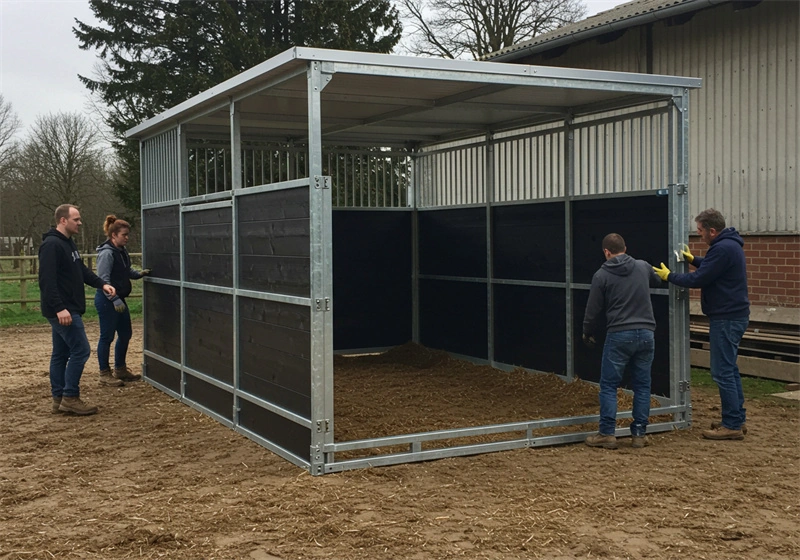
Importing custom horse stables into New Zealand or Australia starts with the spec sheet. If the frame isn’t hot-dip galvanized to a verified 42-micron minimum, you’re importing rust. NZ coastal farms and Australian inland properties both accelerate corrosion — just in different ways. Salt spray eats thin coatings in months; ammonia from bedding eats standard paint in under a year. The only coating that survives both is HDG, and only if the supplier can prove the thickness with a calibrated gauge report.
- Material spec to demand: Hot-dip galvanized steel, >42 microns per ISO 1461. HDPE panels at 10mm thickness with UV stabilizers — not the 6mm commodity board that warps under direct sun.
- Flat pack logistics: A 40-foot high-cube container holds 8 to 12 single stables depending on roof design. That’s roughly 60% less ocean freight per unit compared to a pre-welded barn. The trade-off is assembly time on site, which a proper kit with numbered parts and a torque-spec guide cuts to under 4 hours per stall for a two-person crew.
- Compliance trap: NZ Building Consent for a portable stable is not automatic. If the structure exceeds 10 square meters or is fixed to a concrete slab, councils often treat it as a permanent building. The workaround is a skid-mounted or bolt-down system on compacted gravel — that keeps it classified as a movable structure under Schedule 1 of the Building Act. Australia’s NCC follows similar logic but state variations exist; Victoria and NSW require an engineer-stamped foundation plan if the stable is attached to services.
The real differentiator for a builder or importer is the packing list. A supplier that ships with a fumigation certificate (ISPM-15 for timber pallets), a bolt-count checklist, and a pre-drilled frame that matches the CAD drawing cuts your site risk to near zero. Without those, you’re gambling on call-backs that eat your margin. DB Stable ships every flat pack kit with a serialized packing list and a photo log of each frame joint — that’s the difference between a 4-hour install and a 2-day headache.
Custom Stable Upgrades to Reduce Labour and Improve Functionality
Rust-free aluminum swivel feeders alone can cut daily feed waste by 30%.
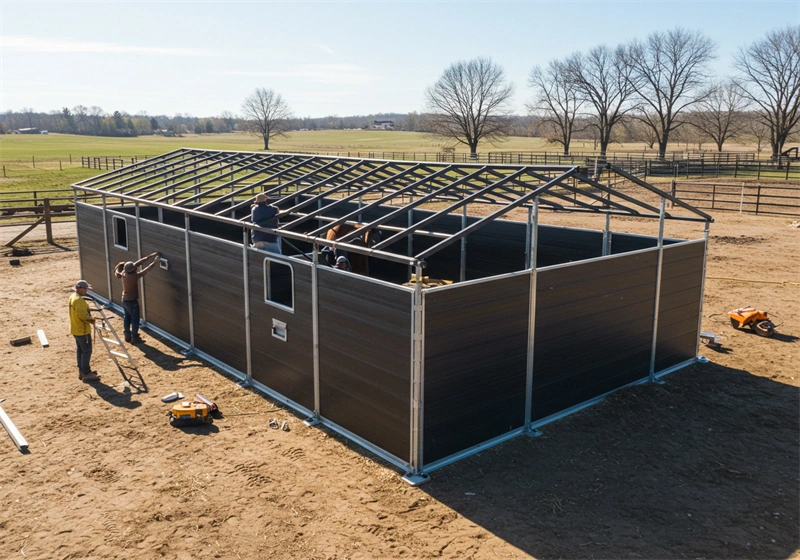
Most builders in the industry are still installing painted steel feeders and galvanized tie rings. Those rust within two winters in NZ’s coastal or high-humidity regions. The result: stuck swivels, broken latches, and a call-back every six months. DB Stable’s rust-free aluminum swivel feeders eliminate that failure mode entirely. They weigh 60% less than steel, so the door hinges don’t sag, and the swivel mechanism stays smooth for the life of the stable. That’s not a marketing claim — it’s a materials fact.
But the labour savings go deeper. A well-designed stable should let a groom or owner do in 15 minutes what used to take 40. That means three specific upgrades: (1) sliding or Dutch doors with integrated hay racks so the horse can eat without the handler entering the stall; (2) a floor drain system sloped at 2% toward a central channel — not just crusher dust over gravel, which packs and ponds in NZ’s high-rain zones; (3) HDPE kick panels that are 10mm thick and UV-resistant, so they don’t warp, crack, or expand in summer heat. Thermal expansion is the hidden labour killer: when HDPE panels push out of their tracks, you spend an hour per panel re-seating them. DB Stable’s 10mm UV-resistant HDPE is formulated to stay dimensionally stable across -10°C to 50°C. That’s a spec you can verify with a caliper.
- Aluminum swivel feeder: Rust-proof, 60% lighter than steel, smooth action for 10+ years. No call-backs for seized latches.
- Sliding door with integrated hay rack: Reduces entry time by 40%. Horse feeds without handler stepping inside — lowers injury risk and labour.
- 2% floor drain slope: Prevents standing water in NZ’s high-rainfall regions. Use 20mm aggregate base with a geotextile membrane.
- 10mm UV-resistant HDPE panels: Zero thermal expansion from -10°C to 50°C. No warping, no re-seating. Competitor 6mm panels fail within 18 months.
The real ROI for a stable builder: every hour you save the end client on daily chores translates into a premium you can charge on the build. Clients who see a 40% labour reduction are willing to pay 15-20% more for the kit. And they never call you back because a feeder rusted shut or a panel popped out. That’s the difference between selling a commodity and selling a system.
Conclusion
A stable kit that arrives with misaligned frames or a missing packing list will burn your margin before the first panel is up. The checklist above cuts that risk — from verifying the HDG coating thickness at delivery to locking the HDPE panels against thermal movement. Follow it, and you hit your assembly time target on the first build.
Review the full HDG frame specs and panel options in the custom stable range before you quote your next NZ project. That way you know exactly what lands on the truck.
Frequently Asked Questions
What is the standard horse stable size?
The standard horse stable size is 12×12 feet (3.6×3.6 meters), which is the most common single stall dimension for flat-pack kits. For larger horses or breeding stock, consider a 14×14. Always confirm stall size with your supplier based on your horse breed.
How tall does a stable door need to be?
A stable door should be at least 2.4 meters (8 feet) high to accommodate most horses safely, especially thoroughbreds. This height prevents head injuries when the horse raises its head and matches the. Specify 2.4m door height in your custom stable order.
How much will it cost to build a stable?
A standard 12x12ft flat-pack single stall from a Chinese factory like DB Stable carries an FOB price of $800 to $1,000, but total landed cost including shipping, GST, and installation can double that. Request a full landed cost quote before comparing suppliers.
What flooring should you have in your horse stalls?
Use a compacted gravel or limestone base topped with rubber mats for drainage and joint protection. Avoid concrete alone, as it is hard on horse legs and can cause injury; a 10mm HDPE. Plan your base layer before the stable kit arrives.
Do I need building consent for a portable stable in NZ?
Yes, you likely need building consent for a portable stable in NZ if it exceeds 10 square meters or is used for commercial purposes like an equestrian center. However, some portable structures under 10m². Verify consent requirements with your council before ordering.