A portfolio page is often the cheapest credibility a stable supplier can buy. Photographs of finished blocks are quick to assemble, usually name no one, and can be swapped out without a trace. A supplier reference installation check is what turns that page into evidence: three installs you can identify, date and telephone, matched against the configuration you are about to buy.
The distance problem is real and worth stating plainly. These units are made in Anping, China, and stand on yards in Australia and New Zealand; production runs at roughly 20 sets a week against a 10-set minimum. You will not drive to the works before a deposit. What you can do is test three claims about yards you can reach, and that is the work below — what to ask for, what each answer proves, and which mismatches should stop a payment.
Key Takeaways
- Ask for three installs, not a gallery: one at your bay count, one with the roof and door type you ordered, one that has been standing through a wet and a dry season.
- A reference photo carries weight through detail you can read — panel and door configuration, the ground it stands on, hardware in focus — not through a caption naming a town.
- Ask for the yard’s own contact and put five questions to it about what arrived, not about what was sold.
- Cross-check every reference against the documented product: 2844×1194×10 mm or 3494×1194×10 mm boards on a 50×50×2.0 mm welded frame, front walls 2200 mm high in 1150 or 1300 mm widths.
- Where no reachable reference exists, a video walkthrough of the works and a signed sample substitute for the visit; neither is an upgrade on it.
What a claimed install proves, and what it does not
A photograph answers one question — does this supplier ship units that stand up in a real yard — and stays silent on the three that matter. It cannot tell you whether that block is the specification you are buying, whether anything went wrong after it landed, or whether the yard would order again.
So read a reference against the configuration sheet instead of the scenery. A six-bay back-to-back block is documented as 11 side panels and 6 doors; if the photo shows a different count, you are looking at a layout you did not quote. Boards come in two published lengths, and a reference set that never says which one was used has not shown you your own order. Roofed references are the same test: the raised steel roof is listed at 2.65 m and 4.6 m long with a 70 cm front eave — a shape you should recognise in the picture.
One position is worth stating here, because it decides what you do with a weak answer: a reference you cannot telephone is marketing, not evidence.
The three references worth asking for
Three, in this order, is the ask that produces something checkable rather than a slide deck. Dealers ordering a first consignment at the 10-set minimum usually need the middle one most; a builder fitting stables for a client needs the first.
| Reference | What it proves | What to ask for |
|---|---|---|
| Same bay count | That the panel and door maths holds once horses are in | Photos of the front wall and one door open, plus the layout sketch |
| Same options | That your roof, door type and accessories were buildable | Close-ups of the door track, latch and any feeder or rack fitted |
| One season old | How the boards, frame and coating behave after weather | A dated photograph, a contact name and what was replaced, if anything |
The dated one is the reference buyers skip and the one that pays. Two to three people and about 30 minutes is the documented assembly figure for a single stable on prepared ground — an assembly number only, not a teardown or relocation time — and a season-old yard can tell you what that figure looked like on their site, with their ground and their people.
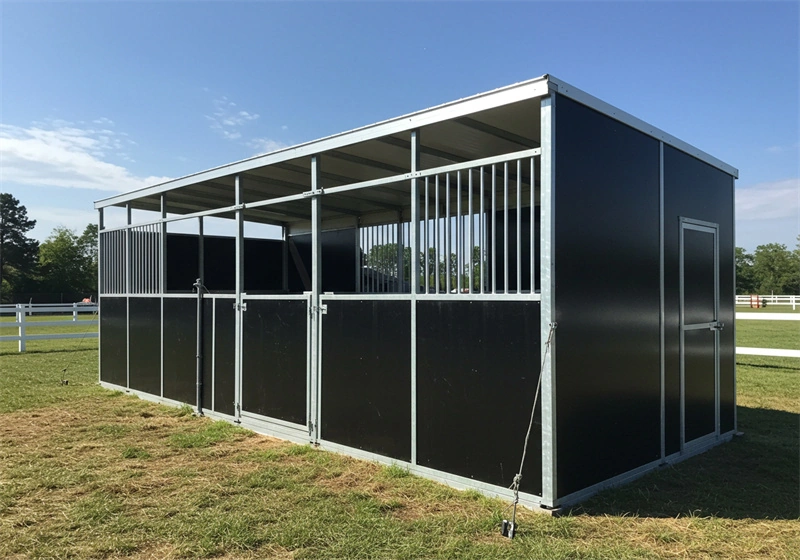
Ask for these three in writing and give a deadline. The useful signal is a supplier who produces dated photographs and a named contact when asked, rather than promising to look for them later, and who hands over export records instead of only describing them.
Five questions for a yard that already bought
A reference call is short and specific. Five questions carry the load, none about appearance.
- What arrived versus what was quoted? Ask which board length was delivered, whether the frame section matched the order, and whether anything was substituted for a component that had to be sourced locally.
- What did the yard have to do before unloading? Boards weigh about 200 kg each, so the honest answer covers machinery, ground preparation and labour, not just a forklift on site.
- How long from deposit to first bay standing? Production time and freight scheduling are not published for these units, which is precisely why the yard that already waited is the better source.
- What has been replaced, and who paid for it? A latch, a hinge pin or a chewed board edge — and whether the spare came from the works or from a local shop.
- What would you specify differently? This is the question that separates a satisfied yard from a polite one.
Two answers deserve a follow-up in writing. If the yard says the coating has held up, ask what was specified: the published position here is a factory commitment of 42 microns and above, with the galvanising process run to AS/NZS 4680, and the standard’s own minimum for 1.5-3 mm wall steel is a separate figure. If the yard says assembly was easy, ask how many people and how much ground prep, because the 30-minute figure is quoted for two to three people on a prepared base.
When no local reference exists
New markets, unusual layouts and a first order mixing panel sizes all produce the same reply: no install you can drive to. That is no reason to proceed on photographs. Three substitutes carry weight, and they differ in kind — one is a documented service, one an arrangement to ask for, one a sign-off you put in writing.
- A live video walkthrough of the works, scheduled and unedited, where you ask to see the welding setup and the boards being stacked. The factory video audit guide sets out what to demand on that call.
- A signed sample or first article, with your configuration table attached and both sides signing, before production is released. The sample approval walk-through covers what that sign-off should record.
- Third-party QC attending the works, which is offered as a service and produces a report from a party independent of the sale.
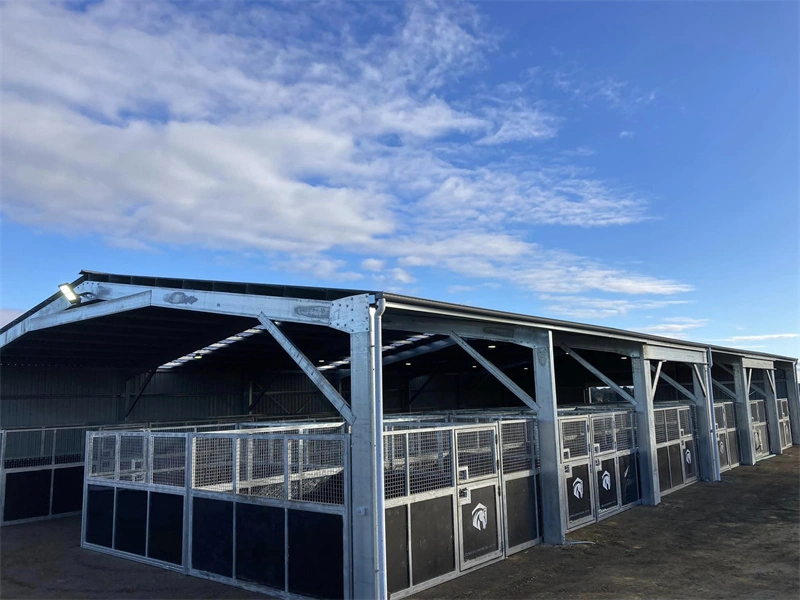
One paper check belongs beside those three. This range is documented with hot-dip galvanising to AS/NZS 4680 and a general compliance statement against ISO and EN systems; certificate numbers are not published on the site, so ask for the copy that names the works, not a logo. If you are working from a broader vetting list, the 12-point supplier checklist covers the company side, and the pre-deposit question set covers what to ask before money moves. This article stops at references.
Frequently Asked Questions
How many references should I ask for?
Three, chosen for what they cover rather than how recent they look: your bay count, your roof and door options, and one that has been through a full season. More than three usually means the supplier is volunteering the easy ones.
What if a supplier refuses to give contacts?
A refusal is often reasonable — many yards do not want unsolicited calls, and some will not release contact details without their customer’s consent. Ask instead for a dated photograph set, a video call at the yard with the owner present, or written permission to name the site.
Are photographs of installs enough on their own?
No. A photo shows a delivered block, not a delivered specification. Check the panel count against your layout, ask which board length is in the picture, and look for the hardware you actually ordered.
Should I visit the factory instead of chasing references?
If you can, a works visit settles questions a phone call cannot. If you cannot, the video walkthrough, a signed sample and third-party QC attendance are the practical replacements, and each one is arranged before a deposit rather than after it.
Conclusion
Three references do different work: the matching layout proves the maths, the matching options prove the build, and the season-old yard proves the durability claims. Together they replace a portfolio page with something a deposit can actually be justified against.
Send the bay count, roof choice and door type you are considering, and ask for those three with dates. If none exists in your market, ask what the video walkthrough, the signed sample and the QC report will say instead.