Ask a carrier for a rural delivery horse stable access quote and you will usually get two answers: a rate to your gate, and a shrug about everything after it. The consignment that clears customs is not the consignment that reaches your paddock, and the gap between them is where the extra day of labour gets spent.
Three constraints sit in that gap, and only one of them is a permit. The others are geometry and unloading method. Our own numbers make the problem concrete: stable panels run 2844 × 1194 × 10 mm or 3494 × 1194 × 10 mm at about 200 kg each, front walls are 2200 mm high, and a raised steel roof section is listed at 4.6 m long. Flat pack keeps the freight volume down; it does not make the last kilometre easy.
Key Takeaways
- Permit, access and unloading are three separate quotes. A freight price that covers the road leg says nothing about your gate, your culvert or your shed corner.
- In Australia, oversize or overmass movements are typically handled as a mass or dimension authority under the Heavy Vehicle National Law; thresholds vary by state and route.
- New Zealand runs the same problem as an overdimension movement under the vehicle dimensions and mass rule, with pilot vehicles and sometimes a designated on-road supervisor.
- The load dimensions that decide access are documented: 3494 mm panels, 2200 mm front walls, 4.6 m roof sections, about 200 kg a panel.
- Do the access audit before you order, not in the delivery week: tape, photographs and a written brief to the carrier cost a morning.
Three constraints, one truck visit
Start with the paperwork. A load that exceeds the standard dimension or mass limits of the vehicle is usually a permitted movement rather than a normal one, and the permit attaches conditions: travel times, routes, pilot cars, sometimes a bridge or crossing inspection. Those are set by the road manager and the permit authority, not by the seller of the stabling.
Then the geometry. Gate pillars, a low shed lintel, a power line across the farm track, a crowned culvert, a corner only a short trailer can turn — none of these are permit problems, and all of them can stop a truck that is legally on the road. A stacked 3494 mm panel and a 4.6 m roof section are the two pieces that turn a confident “get it up the drive” into a phone call.
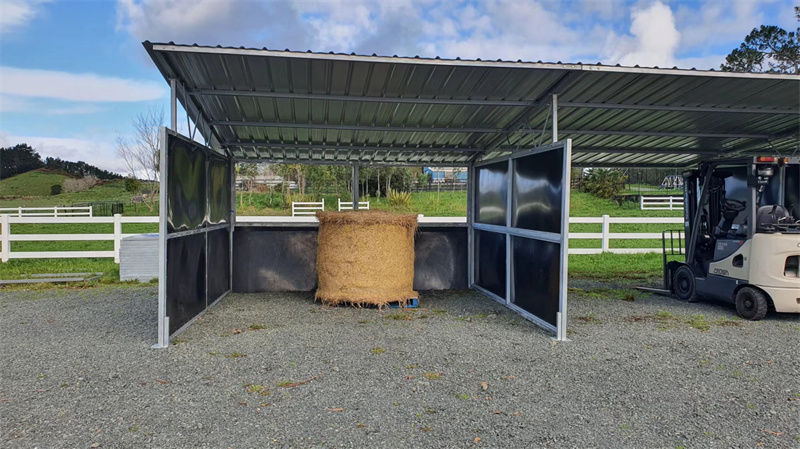
Third is unloading method. Panels are about 200 kg, so the tail-end plan is a machine, a crew, or a staging spot a machine can reach. The photograph above shows a forklift already on site — the version that goes well. Where no machine exists, the answer is a crane truck or a staged drop, booked rather than improvised. Unloading and handling 200 kg panels without machinery works through that choice.
What the permit system actually asks of you
In Australia the framework is the Heavy Vehicle National Law as it applies in each state and territory. Oversize and overmass combinations generally sit in the restricted-access class, which typically means an operator needs a mass or dimension authority before the movement, with the National Heavy Vehicle Regulator processing permits in participating states. Western Australia runs its own arrangements. Escort rules and travel windows vary with the load and the route, so treat any broker’s figure as route-specific and get it in writing.

In New Zealand the same movement is handled as overdimension, under the land transport rule covering vehicle dimensions and mass. Pilot vehicle numbers, briefing duties and whether an on-road supervisor must be designated depend on the load and the permit conditions. Again: the rule sets the shape of the obligation, the permit sets the specifics, and the carrier is the party who has to name them.
Two practical points follow. The permit is normally the carrier’s to obtain and yours to fund knowingly: ask which leg it covers and what it obliges you to provide on the day, including access at the far end. And an oversize permit does not create a widened gate — confirm current requirements with the permit authority or road manager for your route rather than relying on what a neighbour’s shed truck did last year.
The access audit you can do with a tape and a phone
Six measurements decide whether a delivery day takes two hours or two days. Walk the route the truck will walk, photograph each pinch point, and record it before the carrier asks. Put the same sheet in front of the freight quote so both describe the same job.
| What to check | How to check it | Who has to agree |
|---|---|---|
| Gate and pinch-point width | Tape the clear opening between posts; measure the tightest point on the whole route | Carrier, against your recorded figure |
| Overhead clearance | Power lines, shed lintels, branch drop; note the height a loaded trailer needs | Powerline or council for any line crossing |
| Culverts and bridges | Photograph each crossing with a person beside it for scale | Road manager or council, before the permit |
| Surface and camber | Walk it after rain; a soft crown moves a loaded trailer sideways | You, and the driver on the day |
| Turning and reverse-in space | Measure the pad the trailer reverses onto; a 4.6 m roof section will not corner tightly | Carrier, or a local operator they will accept |
| Carry distance to the footprint | Tape from park spot to where panels land; panels are about 200 kg each | Your crew plan, or a machine on site |
Who quotes which leg of the journey
Freight legs are priced separately, and the naming is where buyers lose money. The ocean and port legs are covered in the east versus west coast port selection guide; depot to gate is a local contract quoted by whoever turns up. Ask which of the three constraints the price covers, and ask for the exclusions in the same email.
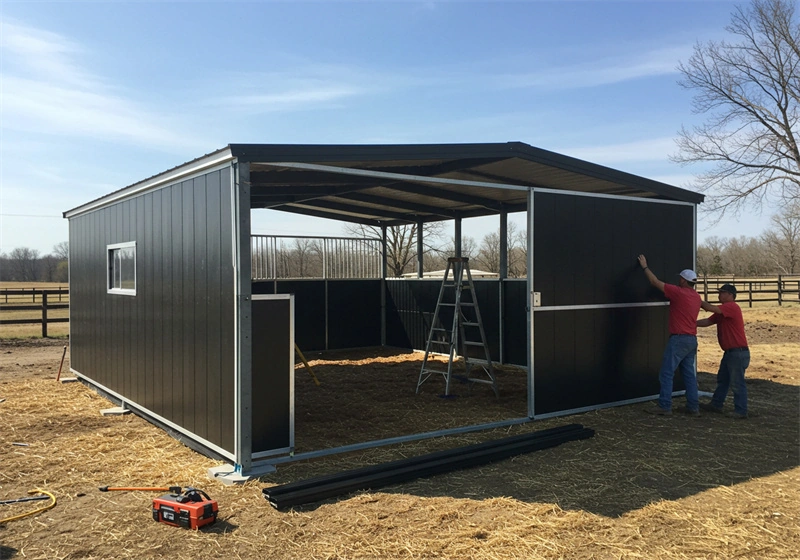
Then plan the tail end. Assembly is documented at two or three people about 30 minutes a set on tool-free corner pins, and that figure covers putting a kit up, not taking one down — with panels already where the work happens. If the truck cannot reach the footprint, the labour line changes before a pin is fitted. Air freight at extra cost shortens the ocean leg only; the panel still lands at a depot and still needs the same access.
Inspect on the day, too. Photograph the load at arrival and file any claim inside the window your carrier sets; the cargo damage and claims walkthrough covers the sequence. On our side, the minimum order is 10 sets against output of about 20 a week, so a dealer’s replenishment often travels inside someone else’s consignment — which makes an access brief more valuable, because you did not choose the truck.
One position on this: access is a pre-order decision. Buyers treat it as a delivery-week problem, and that is when the fix costs a crane hire and a lost working day rather than a morning with a tape measure. Trade terms and who pays each leg are not published on this site — put them to your supplier in writing before the deposit, alongside the access sheet.
Frequently Asked Questions
Who arranges the oversize permit for a stable delivery?
Usually the carrier or their broker, because the authority is tied to the vehicle and driver. You supply the access information and often pay for it — confirm the split in writing.
Will a flat-pack stable load need a permit at all?
Often not, since flat pack keeps the volume down — but long items such as 4.6 m roof sections and stacked 3494 mm panels can push a combination past standard limits. Ask the carrier to name the class before booking.
What if my farm gate is narrower than the load?
Then the delivery becomes a staged drop: the truck parks clear of the pinch point and the panels carry on from there. With panels at about 200 kg, plan a machine or a crew for that distance.
Does the 30-minute assembly figure include the delivery day?
No. It covers two or three people erecting a set on tool-free corner pins, with panels already on site and accessible. Unloading and carry time are separate.
Conclusion
A stable block that arrives intact and cannot reach the yard is not a logistics failure; it is an ordering failure. The permit, the geometry and the unloading method are three known quantities, and all three can be written down before a deposit is paid.
Send the access sheet with the drawings, then hold the documented portable horse stable panel and roof sizes against the figures your carrier gives you, so the quote and the delivery describe the same job.