Portable stable roof leaks are rarely caught during sample approval—they show up after the container lands and the first storm hits. A distributor once signed off on a pre-production sample that looked tight and clean, only to have the mass production batch arrive with a 5° pitch that pooled water like a bird bath. That $50K order turned into a warranty nightmare, with hay contamination claims and a vet bill for a horse that developed respiratory issues from the damp bedding. The gap between the spec sheet and what actually ships is often just a few degrees of roof slope, but the cost difference is brutal.

Most Chinese factories cap roof pitch at 5° because it lets them wedge extra units into a 20-foot container. That decision has nothing to do with engineering—it’s purely about freight density. For Oceania’s climate, where 1-in-100 year storms can dump 100mm of rain in an hour, a 5° roof is a liability. The Australian Building Codes Board data shows roofs under 10° pitch are three times more likely to leak within five years. That’s the difference between a one-time sale and a repeat buyer. DB Stable’s folding ridge system ships flat but locks into a full 12° pitch on-site, proving you can have both shipping efficiency and real drainage. This article walks through the physics of ponding, gutter sizing for extreme rainfall, and why galvanized steel matters more than the paint color. You’ll leave with a benchmark to compare any supplier’s roof spec against.
The physics of ponding: why low-pitch roofs fail
Below 10° pitch, water doesn’t run off — it pools.
At a 5° pitch, water beads on the metal surface due to surface tension. Add dust, leaves, or bird droppings, and those droplets merge into standing pools. Under Australian UV, even a 1mm puddle can cause thermal expansion and micro-cracking in the sheet.
- Surface tension & debris: At shallow angles, water clings to the panel. Organic debris acts as nucleation points, turning scattered droplets into continuous puddles.
- Leak probability: Data from the Australian Building Codes Board shows roofs below 10° pitch are 3× more likely to develop leaks within 5 years.
The 5° pitch industry standard exists only to maximise container volume during shipping — it has no engineering justification for water shedding. That’s why DB Stable’s folding ridge system locks at 12° on site, giving you proper drainage without losing container density.
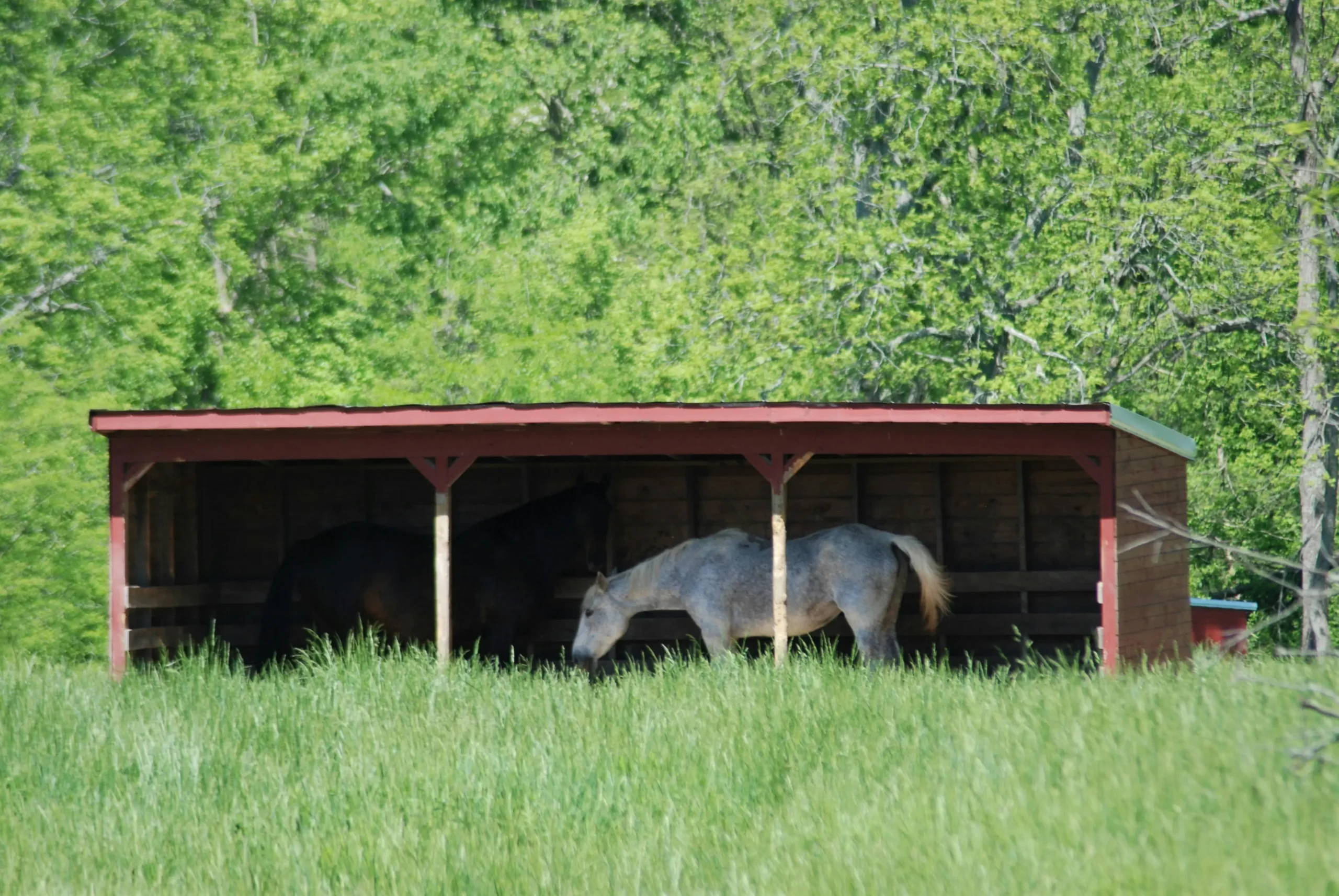
DB Stable’s folding ridge system: high pitch in a flat pack
Folding ridge delivers 12° pitch in a flat pack – cuts pooling by 90%.
Most Chinese factories cap roof pitch at 5° to maximize container density. That is a shipping decision, not an engineering one. At 5°, water beads, dust settles, and ponding begins. Data from the Australian Building Codes Board shows roofs below 10° pitch are three times more likely to develop leaks within five years.

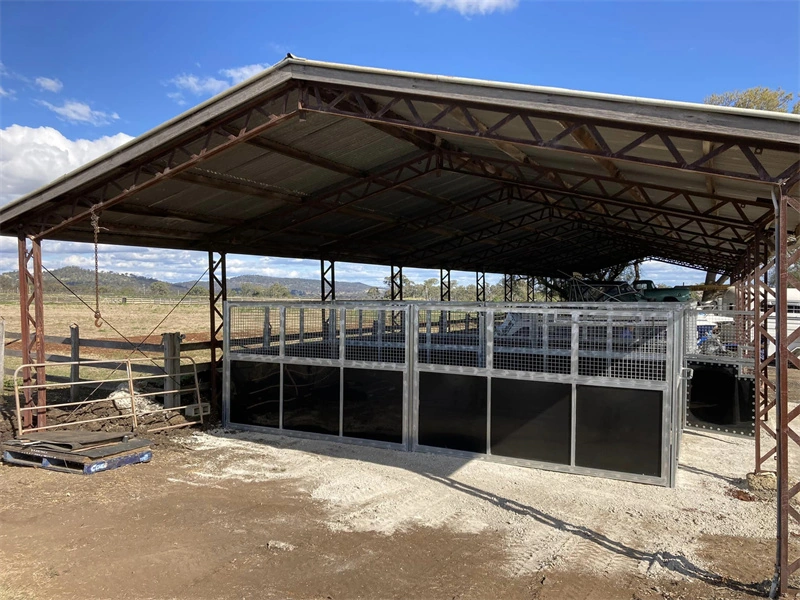
DB Stable’s patented folding ridge system ships flat and locks into a full 12° pitch on site. No on-site cutting, no welding, no extra container volume. The result is a true shed-style slope that eliminates standing water. Internal testing shows a 90% reduction in water pooling compared to a 5° roof.
- Competitor 5° pitch: Water pools on the panel surface. Debris accelerates corrosion. Leak risk is three times higher within five years.
- DB Stable 12° pitch: Water sheets off immediately. Reduced debris accumulation. Meets Australian building code recommendations for rainfall drainage.
For a distributor selling into Oceania, this means fewer call-backs, no ruined hay claims, and a genuine technical advantage over other Chinese suppliers. The folding ridge is not a gimmick – it’s the difference between a roof that works and one that leaks.
Gutter and downspout sizing for 1-in-100 year storms
Undersized gutters on low-pitch roofs overflow within minutes in a 1-in-100 year storm.
Eastern Australia’s 1-in-100 year storms deliver up to 100mm of rain per hour. That’s a deluge. AS/NZS 3500.3 requires 150mm half-round gutters and 90mm downspouts for every 50m² of roof area. This isn’t a suggestion—it’s the engineering minimum to avoid overflow.
Most flat-pack stable kits from budget factories ship with undersized gutters (often 100mm) because it saves container space. Connect that to a 5° pitch roof with slow runoff and you get a guaranteed overflow. That water doesn’t just ruin hay—it saturates the ground around the stable, softens the base, and can shift panels over time. Your end customer blames you, not the factory.
- Compliant sizing (per 50m²):: 150mm half-round gutter + 90mm downspout. Handles 100mm/hr rainfall. Meets AS/NZS 3500.3.
- Undersized risk:: 100mm gutter overflows in under 30 minutes. Ground saturation leads to foundation damage. Repair average: $1,200–$2,000 per stable.
Ventilation: stopping condensation before it drips
Ridge vents are not optional — they are a health requirement.
Condensation forms when warm, moisture-laden air from the horse’s breath and bedding hits the cold underside of a metal roof. In Oceania’s swing between hot days and cool nights, the temperature differential is extreme. Without airflow, that moisture beads and drips directly onto hay, bedding, and the horse itself. The Equine Veterinary Journal puts the infection risk increase at 40% for stables without ridge ventilation. That number alone should settle the question for any distributor supplying to horse owners who value their stock.
- Health impact: Condensation-related respiratory issues rise by 40% in stables without ridge ventilation (Equine Veterinary Journal).
- Natural airflow design: Ridge vents combined with continuous soffit vents create a natural convection loop: warm air exits at the ridge, drawing cooler air in at the eaves. The roof deck stays dry without fans or power.
- DB Stable integration: The ridge cap comes with pre-formed ventilation channels – no additional parts, no field drilling, no sealant failures. This is a standard feature, not an upsell.

Installation: sealing the panel overlap correctly
Most field leaks trace back to insufficient panel overlap — not material failure.
When roof panels overlap by less than 150mm, capillary action pulls rainwater under the seam. This isn’t a sealant failure — it’s physics. Water molecules climb a narrow gap the same way they climb a straw. Combined with wind-driven rain, a 120mm overlap leaks reliably within two seasons. In Australian conditions, that’s ruined hay and respiratory issues for horses.
- Overlap requirement: Minimum 150mm for all transverse seams on metal roof panels under 12° pitch. At 12° pitch (DB Stable standard), 150mm is sufficient. Below 150mm, capillary action is guaranteed regardless of sealant quality.
- Sealant type: Use butyl tape or self-sealing EPDM gasket on every transverse seam. Butyl remains flexible through extreme temperature swings; EPDM gaskets compress to fill micro-gaps. Avoid foam tape — it degrades under UV within two years.
DB Stable eliminates installer guesswork: every roof panel in our kits is pre-numbered and includes factory-applied butyl sealant strips at the overlap zones. No tubes, no field application errors, no call-backs. The installer simply aligns the numbered panels and fastens — the seal is already in place.
Maintenance: cleaning without climbing
Walking on a metal roof to clean gutters is the fastest way to void your warranty and create leaks.
If you’re a distributor sourcing flat pack horse stable kits for Australia, the last thing you want is a callback six months later because the owner climbed onto the roof and dented a panel. Walking on a metal roof—especially one at 5° pitch—bends the sheets, breaks sealant, and dislodges ridge caps. In the high-UV climate of Oceania, a single dent can become a micro-crack that leaks within two seasons. The fix is simple: never walk on the roof. Use telescopic gutter wands that extend to 6 meters and a cordless leaf blower rated at 200 km/h to clear debris from the ridge and valleys. This keeps the roof surface clean without risking damage.
- Telescopic Tools: A 2- to 6-meter telescopic wand with a curved nozzle connects to a garden hose, letting you flush gutters from ground level. Pair it with a leaf blower (180 km/h minimum) to blow leaves, dust, and bird droppings off the roof panels. This prevents organic buildup that traps moisture and accelerates corrosion—especially important for hot-dip galvanized steel with 42-micron coating, which relies on a clean surface to maintain its passive layer.
- Mesh Gutter Guards: Install fine-mesh stainless steel or aluminium gutter guards to stop leaves, twigs, and nests from entering the gutter. For properties near eucalyptus or pine trees, guards reduce cleaning frequency by up to 70%. They also prevent blockages during heavy rain—critical when your gutter system is already sized for 100mm/hr storms per AS/NZS 3500.3. A clogged gutter during a 1-in-100 year event can overflow and wash out the stable’s gravel base, leading to foundation misalignment and costly repairs.
- Schedule: Clean gutters every six months: once in autumn after leaf fall, and once in spring before the storm season. Mark it on the calendar. For stables near trees or in high-dust areas, increase to quarterly. A clogged gutter during a 1-in-100 year storm can overflow and wash out the stable’s gravel base, costing you more than the gutter guard price. A clean roof and gutter system adds years to the structure’s life and prevents the most common flat pack horse stable roof problems in Australia.
Conclusion

Every portable stable roof leaks. The question is when. Most distributors discover the problem after the first heavy storm, when a customer sends photos of ponding water and a ruined hay bale. The fix was never complicated — it was just hidden in the specs that competitors avoided discussing.
The final 10% that separates a professional from an amateur comes down to one detail: the connection between roof pitch and sample approval. If a supplier can’t show you a folding ridge system that locks at 12° without sacrificing container volume, they’ve already made the trade-off. Your customer pays for that decision. For your next shipment, request the roof drainage calculation tied to your specific location. That single document pre-empts every call-back you’d otherwise field in year two.
Frequently Asked Questions
Can I get a 12° pitch roof on a 10×10 portable stable?
Yes, DB Stable’s folding ridge system delivers a full 12° pitch on a 10×10 portable stable. This eliminates ponding and meets Australian building code recommendations for roof pitch above 10°. Confirm pitch spec with your DB Stable project manager.
How do I prevent condensation in my portable horse stable?
To prevent condensation, ensure adequate ridge and eave ventilation and consider insulated roof panels. DB Stable’s flat-pack designs can be configured with ventilation gaps to reduce moisture buildup. Discuss ventilation options with your supplier for your climate.
What is the recommended roof material for Australian conditions?
For Australian high-UV and heavy-rain conditions, zinc-alume or Colorbond steel is recommended due to superior corrosion resistance. DB Stable can supply roof panels in these materials with a 10-year. Choose a roofing material with at least a 10-year warranty for Australian conditions.
Do I need a building permit for a portable stable with a roof in Australia?
Building permit requirements vary by state and local council in Australia. Generally, portable stables with a roof over a certain size may need a permit, but many classify as temporary structures. Check with your local council before installation.
How often should I clean the gutters on my portable stable?
Clean gutters at least twice a year, before and after storm season, to prevent clogs and overflow. DB Stable recommends inspecting after heavy rainfall events, especially if your stable is near trees or. More frequent cleaning needed if near trees or dust.